
- Q1.Physics
A tuning fork is used to produce resonance in a glass tube. The length of the air column in this tube can be adjusted by a variable piston. At room temperature of 27°C two successive resonances are produced at 20 cm and 73 cm of column length. If the frequency of the tuning fork is 320 Hz, the velocity of sound in air at 27°C is
A330 m/sB339 m/sC300 m/sD350 m/s - Q2.Physics
An electron falls from rest through a vertical distance h in a uniform and vertically upward directed electric field E. The direction of electric field is now reversed, keeping its magnitude the same. A proton is allowed to fall from rest in it through the same vertical distance h. The time of fall of the electron, in comparison to the time of fall of the proton is
AsmallerB5 times greaterCequalD10 times greater - Q3.Physics
A pendulum is hung from the roof of a sufficiently high building and is moving freely to and fro like a simple harmonic oscillator. The acceleration of the bob of the pendulum is 20 m/s² at a distance of 5 m from the mean position. The time period of oscillation is
A2π sBπ sC1 sD2 s - Q4.Physics
The electrostatic force between the metal plates of an isolated parallel plate capacitor C having a charge Q and area A, is
Aindependent of the distance between the plates.Blinearly proportional to the distance between the plates.Cinversely proportional to the distance between the plates.Dproportional to the square root of the distance between the plates. - Q5.Physics
Current sensitivity of a moving coil galvanometer is 5 div/mA and its voltage sensitivity (angular deflection per unit voltage applied) is 20 div/V. The resistance of the galvanometer is
A40 ΩB25 ΩC500 ΩD250 Ω - Q6.Physics
A thin diamagnetic rod is placed vertically between the poles of an electromagnet. When the current in the electromagnet is switched on, then the diamagnetic rod is pushed up, out of the horizontal magnetic field. Hence the rod gains gravitational potential energy. The work required to do this comes from
Athe current sourceBthe magnetic fieldCthe induced electric field due to the changing magnetic fieldDthe lattice structure of the material of the rod - Q7.Physics
An inductor 20 mH, a capacitor 100 μF and a resistor 50 Ω are connected in series across a source of emf, V = 10 sin 314 t. The power loss in the circuit is
A0·79 WB0·43 WC1·13 WD2·74 W - Q8.Physics
A metallic rod of mass per unit length 0·5 kg m⁻¹ is lying horizontally on a smooth inclined plane which makes an angle of 30° with the horizontal. The rod is not allowed to slide down by flowing a current through it when a magnetic field of induction 0·25 T is acting on it in the vertical direction. The current flowing in the rod to keep it stationary is
A7·14 AB5·98 AC11·32 AD14·76 A - Q9.Physics
A carbon resistor of (47 ± 4·7) kΩ is to be marked with rings of different colours for its identification. The colour code sequence will be
AViolet – Yellow – Orange – SilverBYellow – Violet – Orange – SilverCGreen – Orange – Violet – GoldDYellow – Green – Violet – Gold - Q10.Physics
A set of 'n' equal resistors, of value 'R' each, are connected in series to a battery of emf 'E' and internal resistance 'R'. The current drawn is I. Now, the 'n' resistors are connected in parallel to the same battery. Then the current drawn from battery becomes 10 I. The value of 'n' is
A10B11C9D20 - Q11.Physics
A battery consists of a variable number 'n' of identical cells (having internal resistance 'r' each) which are connected in series. The terminals of the battery are short-circuited and the current I is measured. Which of the graphs shows the correct relationship between I and n?
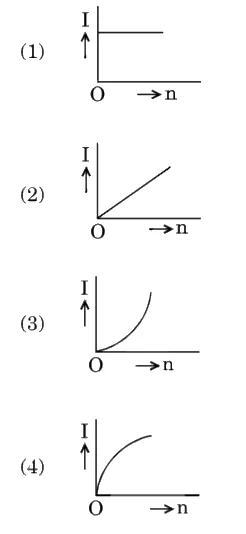 A[Graph showing linear increase from origin]B[Graph showing linear increase starting from origin, then curving upward]C[Graph showing a curve that increases and levels off]D[Graph showing a curve that increases rapidly from origin]
 - Q12.Physics
In Young's double slit experiment the separation d between the slits is 2 mm, the wavelength λ of the light used is 5896 Å and distance D between the screen and slits is 100 cm. It is found that the angular width of the fringes is 0·20°. To increase the fringe angular width to 0·21° (with same λ and D) the separation between the slits needs to be changed to
A1·8 mmB1·9 mmC1·7 mmD2·1 mm - Q13.Physics
An astronomical refracting telescope will have large angular magnification and high angular resolution, when it has an objective lens of
Asmall focal length and large diameterBlarge focal length and small diameterCsmall focal length and small diameterDlarge focal length and large diameter - Q14.Physics
Unpolarised light is incident from air on a plane surface of a material of refractive index 'μ'. At a particular angle of incidence 'i', it is found that the reflected and refracted rays are perpendicular to each other. Which of the following options is correct for this situation?
AReflected light is polarised with its electric vector parallel to the plane of incidenceBReflected light is polarised with its electric vector perpendicular to the plane of incidenceCD - Q15.Physics
An em wave is propagating in a medium with a velocity . The instantaneous oscillating electric field of this em wave is along +y axis. Then the direction of oscillating magnetic field of the em wave will be along
A– z directionB+ z directionC– x directionD– y direction - Q16.Physics
The refractive index of the material of a prism is √2 and the angle of the prism is 30°. One of the two refracting surfaces of the prism is made a mirror inwards, by silver coating. A beam of monochromatic light entering the prism from the other face will retrace its path (after reflection from the silvered surface) if its angle of incidence on the prism is
A60°B45°CzeroD30° - Q17.Physics
An object is placed at a distance of 40 cm from a concave mirror of focal length 15 cm. If the object is displaced through a distance of 20 cm towards the mirror, the displacement of the image will be
A30 cm away from the mirrorB36 cm away from the mirrorC36 cm towards the mirrorD30 cm towards the mirror - Q18.Physics
The magnetic potential energy stored in a certain inductor is 25 mJ, when the current in the inductor is 60 mA. This inductor is of inductance
A0·138 HB138·88 HC13·89 HD1·389 H - Q19.Physics
For a radioactive material, half-life is 10 minutes. If initially there are 600 number of nuclei, the time taken (in minutes) for the disintegration of 450 nuclei is
A20B10C15D30 - Q20.Physics
The ratio of kinetic energy to the total energy of an electron in a Bohr orbit of the hydrogen atom, is
A1 : 1B1 : – 1C1 : – 2D2 : – 1 - Q21.Physics
An electron of mass m with an initial velocity (V₀ > 0) enters an electric field (E₀ = constant > 0) at t = 0. If λ₀ is its de-Broglie wavelength initially, then its de-Broglie wavelength at time t is
ABCD - Q22.Physics
When the light of frequency 2ν₀ (where ν₀ is threshold frequency), is incident on a metal plate, the maximum velocity of electrons emitted is v₁. When the frequency of the incident radiation is increased to 5ν₀, the maximum velocity of electrons emitted from the same plate is v₂. The ratio of v₁ to v₂ is
A1 : 2B1 : 4C2 : 1D4 : 1 - Q23.Physics
In the combination of the following gates the output Y can be written in terms of inputs A and B as
[Diagram showing logic gate circuit]
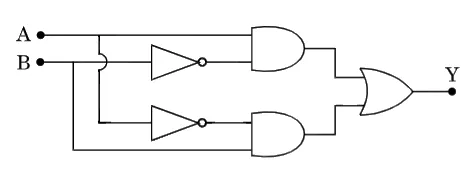 ABCD
ABCD - Q24.Physics
In the circuit shown in the figure, the input voltage Vᵢ is 20 V, V_BE = 0 and V_CE = 0. The values of I_B, I_C and β are given by
[Diagram showing transistor circuit with R_B = 500 kΩ, R_C = 4 kΩ, V_i = 20 V]
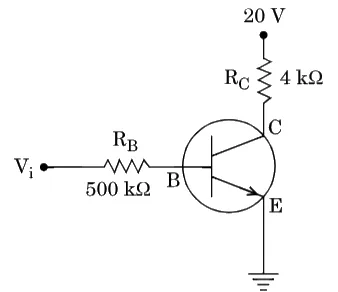 A μA, mA,B μA, mA,C μA, mA,D μA, mA,
 - Q25.Physics
In a p-n junction diode, change in temperature due to heating
Aaffects only reverse resistanceBaffects only forward resistanceCaffects the overall V – I characteristics of p-n junctionDdoes not affect resistance of p-n junction - Q26.Physics
A solid sphere is rotating freely about its symmetry axis in free space. The radius of the sphere is increased keeping its mass same. Which of the following physical quantities would remain constant for the sphere?
AAngular velocityBMoment of inertiaCAngular momentumDRotational kinetic energy - Q27.Physics
The kinetic energies of a planet in an elliptical orbit about the Sun, at positions A, B and C are K_A, K_B and K_C, respectively. AC is the major axis and SB is perpendicular to AC at the position of the Sun S as shown in the figure. Then
[Diagram: Ellipse with major axis AC, Sun at S, point B on the ellipse such that SB ⊥ AC]
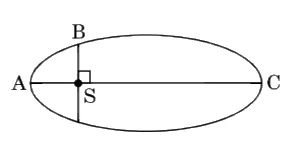 ABCD
ABCD - Q28.Physics
If the mass of the Sun were ten times smaller and the universal gravitational constant were ten times larger in magnitude, which of the following is not correct?
ARaindrops will fall faster.BWalking on the ground would become more difficult.C'g' on the Earth will not change.DTime period of a simple pendulum on the Earth would decrease. - Q29.Physics
A solid sphere is in rolling motion. In rolling motion a body possesses translational kinetic energy (K_t) as well as rotational kinetic energy (K_r) simultaneously. The ratio K_t : (K_t + K_r) for the sphere is
A7 : 10B5 : 7C2 : 5D10 : 7 - Q30.Physics
A small sphere of radius 'r' falls from rest in a viscous liquid. As a result, heat is produced due to viscous force. The rate of production of heat when the sphere attains its terminal velocity, is proportional to
ABCD - Q31.Physics
A sample of 0·1 g of water at 100°C and normal pressure (1·013 × 10⁵ Nm⁻²) requires 54 cal of heat energy to convert to steam at 100°C. If the volume of the steam produced is 167·1 cc, the change in internal energy of the sample, is
A104·3 JB208·7 JC84·5 JD42·2 J - Q32.Physics
Two wires are made of the same material and have the same volume. The first wire has cross-sectional area A and the second wire has cross-sectional area 3A. If the length of the first wire is increased by Δl on applying a force F, how much force is needed to stretch the second wire by the same amount?
A9 FB6 FCFD4 F - Q33.Physics
The power radiated by a black body is P and it radiates maximum energy at wavelength, . If the temperature of the black body is now changed so that it radiates maximum energy at wavelength , the power radiated by it becomes nP. The value of n is
ABCD - Q34.Physics
At what temperature will the rms speed of oxygen molecules become just sufficient for escaping from the Earth's atmosphere?
Given: Mass of oxygen molecule (m) = kg, Boltzmann's constant J K
A KB KC KD K - Q35.Physics
The volume (V) of a monatomic gas varies with its temperature (T), as shown in the graph. The ratio of work done by the gas, to the heat absorbed by it, when it undergoes a change from state A to state B, is [Diagram: V-T graph with points A and B marked, showing linear relationship]
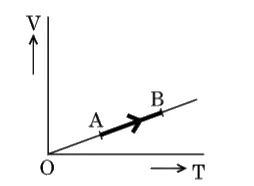 ABCD
ABCD - Q36.Physics
The fundamental frequency in an open organ pipe is equal to the third harmonic of a closed organ pipe. If the length of the closed organ pipe is 20 cm, the length of the open organ pipe is
A13.2 cmB8 cmC16 cmD12.5 cm - Q37.Physics
The efficiency of an ideal heat engine working between the freezing point and boiling point of water, is
A26.8%B20%C12.5%D6.25% - Q38.Physics
A body initially at rest and sliding along a frictionless track from a height h (as shown in the figure) just completes a vertical circle of diameter AB = D. The height h is equal to [Diagram: body sliding down and completing a vertical circular loop]
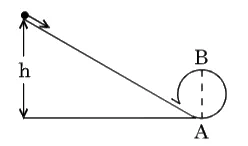 ABCD
ABCD - Q39.Physics
Three objects, A : (a solid sphere), B : (a thin circular disk) and C : (a circular ring), each have the same mass M and radius R. They all spin with the same angular speed about their own symmetry axes. The amounts of work (W) required to bring them to rest, would satisfy the relation
ABCD - Q40.Physics
Which one of the following statements is incorrect?
ARolling friction is smaller than sliding friction.BLimiting value of static friction is directly proportional to normal reaction.CCoefficient of sliding friction has dimensions of length.DFrictional force opposes the relative motion. - Q41.Physics
A moving block having mass m, collides with another stationary block having mass 4m. The lighter block comes to rest after collision. When the initial velocity of the lighter block is v, then the value of coefficient of restitution (e) will be
A0.5B0.25C0.4D0.8 - Q42.Physics
A block of mass m is placed on a smooth inclined wedge ABC of inclination as shown in the figure. The wedge is given an acceleration 'a' towards the right. The relation between a and for the block to remain stationary on the wedge is [Diagram: block on inclined wedge]
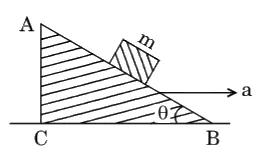 ABCD
ABCD - Q43.Physics
A toy car with charge q moves on a frictionless horizontal plane surface under the influence of a uniform electric field . Due to the force , its velocity increases from 0 to 6 m/s in one second duration. At that instant the direction of the field is reversed. The car continues to move for two more seconds under the influence of this field. The average velocity and the average speed of the toy car between 0 to 3 seconds are respectively
A2 m/s, 4 m/sB1 m/s, 3 m/sC1.5 m/s, 3 m/sD1 m/s, 3.5 m/s - Q44.Physics
The moment of the force, at (2, 0, –3), about the point (2, –2, –2), is given by
ABCD - Q45.Physics
A student measured the diameter of a small steel ball using a screw gauge of least count 0.001 cm. The main scale reading is 5 mm and zero of circular scale division coincides with 25 divisions above the reference level. If screw gauge has a zero error of –0.004 cm, the correct diameter of the ball is
A0.521 cmB0.525 cmC0.529 cmD0.053 cm - Q46.Biology
The difference between spermiogenesis and spermiation is
AIn spermiogenesis spermatids are formed, while in spermiation spermatozoa are formed.BIn spermiogenesis spermatozoa are formed, while in spermiation spermatids are formed.CIn spermiogenesis spermatozoa are formed, while in spermiation spermatozoa are released from sertoli cells into the cavity of seminiferous tubules.DIn spermiogenesis spermatozoa from sertoli cells are released into the cavity of seminiferous tubules, while in spermiation spermatozoa are formed. - Q47.Biology
The amnion of mammalian embryo is derived from
Aectoderm and mesodermBendoderm and mesodermCectoderm and endodermDmesoderm and trophoblast - Q48.Biology
The contraceptive 'SAHELI'
Ablocks estrogen receptors in the uterus, preventing eggs from getting implanted.Bincreases the concentration of estrogen and prevents ovulation in females.Cis a post-coital contraceptive.Dis an IUD. - Q49.Biology
Hormones secreted by the placenta to maintain pregnancy are
AhCG, hPL, progestogens, prolactinBhCG, hPL, estrogens, relaxin, oxytocinChCG, progestogens, estrogens, glucocorticoidsDhCG, hPL, progestogens, estrogens - Q50.Biology
Match the items given in Column I with those in Column II and select the correct option given below:
Column I Column II
a. Proliferative Phase i. Breakdown of endometrial lining
b. Secretory Phase ii. Follicular Phase
c. Menstruation iii. Luteal Phase
Aa-iii, b-ii, c-iBa-i, b-iii, c-iiCa-iii, b-i, c-iiDa-ii, b-iii, c-i - Q51.Biology
All of the following are part of an operon except
Aan operatorBstructural genesCa promoterDan enhancer - Q52.Biology
A woman has an X-linked condition on one of her X chromosomes. This chromosome can be inherited by
AOnly daughtersBOnly sonsCBoth sons and daughtersDOnly grandchildren - Q53.Biology
According to Hugo de Vries, the mechanism of evolution is
AMultiple step mutationsBSaltationCMinor mutationsDPhenotypic variations - Q54.Biology
AGGTATCGCAT is a sequence from the coding strand of a gene. What will be the corresponding sequence of the transcribed mRNA?
AAGGUAUCGCAUBUGGTUTCGCATCUCCAUAGCGUADACCUAUGCGAU - Q55.Biology
Among the following sets of examples for divergent evolution, select the incorrect option:
AForelimbs of man, bat and cheetahBHeart of bat, man and cheetahCEye of octopus, bat and manDBrain of bat, man and cheetah - Q56.Biology
Conversion of milk to curd improves its nutritional value by increasing the amount of
AVitamin DBVitamin ACVitamin EDVitamin B12 - Q57.Biology
Which of the following is not an autoimmune disease?
APsoriasisBRheumatoid arthritisCVitiligoDAlzheimer's disease - Q58.Biology
The similarity of bone structure in the forelimbs of many vertebrates is an example of
AHomologyBAnalogyCAdaptive radiationDConvergent evolution - Q59.Biology
Which of the following characteristics represent 'Inheritance of blood groups' in humans?
a. Dominance
b. Co-dominance
c. Multiple allele
d. Incomplete dominance
e. Polygenic inheritance
Ab, c and eBa, b and cCa, c and eDb, d and e - Q60.Biology
In which disease does mosquito transmitted pathogen cause chronic inflammation of lymphatic vessels?
AElephantiasisBAscariasisCAmoebiasisDRingworm disease - Q61.Biology
All of the following are included in 'Ex-situ conservation' except
AWildlife safari parksBSacred grovesCSeed banksDBotanical gardens - Q62.Biology
Which part of poppy plant is used to obtain the drug ''Smack''?
AFlowersBLatexCLeavesDRoots - Q63.Biology
In a growing population of a country,
Apre-reproductive individuals are more than the reproductive individuals.Breproductive individuals are less than the post-reproductive individuals.Cpre-reproductive individuals are less than the reproductive individuals.Dreproductive and pre-reproductive individuals are equal in number. - Q64.Biology
Which one of the following population interactions is widely used in medical science for the production of antibiotics?
ACommensalismBMutualismCAmensalismDParasitism - Q65.Biology
Match the items given in Column I with those in Column II and select the correct option given below:
Column I Column II
a. Eutrophication i. UV-B radiation
b. Sanitary landfill ii. Deforestation
c. Snow blindness iii. Nutrient enrichment
d. Jhum cultivation iv. Waste disposal
Aa-ii, b-i, c-iii, d-ivBa-i, b-iii, c-iv, d-iiCa-i, b-ii, c-iv, d-iiiDa-iii, b-iv, c-i, d-ii - Q66.Biology
Which of the following options correctly represents the lung conditions in asthma and emphysema, respectively?
AInflammation of bronchioles; Decreased respiratory surfaceBIncreased number of bronchioles; Increased respiratory surfaceCDecreased respiratory surface; Inflammation of bronchiolesDIncreased respiratory surface; Inflammation of bronchioles - Q67.Biology
Match the items given in Column I with those in Column II and select the correct option given below:
Column I Column II
a. Tricuspid valve i. Between left atrium and left ventricle
b. Bicuspid valve ii. Between right ventricle and pulmonary artery
c. Semilunar valve iii. Between right atrium and right ventricle
Aa-iii, b-i, c-iiBa-i, b-iii, c-iiCa-ii, b-i, c-iiiDa-i, b-ii, c-iii - Q68.Biology
Match the items given in Column I with those in Column II and select the correct option given below:
Column I Column II
a. Tidal volume i. 2500 – 3000 mL
b. Inspiratory Reserve volume ii. 1100 – 1200 mL
c. Expiratory Reserve volume iii. 500 – 550 mL
d. Residual volume iv. 1000 – 1100 mL
Aa-iii, b-ii, c-i, d-ivBa-iii, b-i, c-iv, d-iiCa-iv, b-iii, c-ii, d-iDa-i, b-iv, c-ii, d-iii - Q69.Biology
Which of the following is an amino acid derived hormone?
AEpinephrineBEcdysoneCEstriolDEstradiol - Q70.Biology
Which of the following structures or regions is incorrectly paired with its function?
AMedulla oblongata: controls respiration and cardiovascular reflexes.BLimbic system: consists of fibre tracts that interconnect different regions of brain; controls movement.CCorpus callosum: band of fibers connecting left and right cerebral hemispheres.DHypothalamus: production of releasing hormones and regulation of temperature, hunger and thirst. - Q71.Biology
The transparent lens in the human eye is held in its place by
Aligaments attached to the ciliary bodyBligaments attached to the irisCsmooth muscles attached to the ciliary bodyDsmooth muscles attached to the iris - Q72.Biology
Which of the following hormones can play a significant role in osteoporosis?
AAldosterone and ProlactinBProgesterone and AldosteroneCParathyroid hormone and ProlactinDEstrogen and Parathyroid hormone - Q73.Biology
Which of the following gastric cells indirectly help in erythropoiesis?
AChief cellsBMucous cellsCParietal cellsDGoblet cells - Q74.Biology
Match the items given in Column I with those in Column II and select the correct option given below:
Column I Column II
a. Fibrinogen i. Osmotic balance
b. Globulin ii. Blood clotting
c. Albumin iii. Defence mechanism
Aa-iii, b-ii, c-iBa-i, b-ii, c-iiiCa-ii, b-iii, c-iDa-i, b-iii, c-ii - Q75.Biology
Which of the following is an occupational respiratory disorder?
AAnthracisBSilicosisCEmphysemaDBotulism - Q76.Biology
Calcium is important in skeletal muscle contraction because it
Abinds to troponin to remove the masking of active sites on actin for myosin.Bactivates the myosin ATPase by binding to it.Cprevents the formation of bonds between the myosin cross bridges and the actin filament.Ddetaches the myosin head from the actin filament. - Q77.Biology
Select the incorrect match:
ALampbrush chromosomes – Diplotene bivalentsBAllosomes – Sex chromosomesCPolytene chromosomes – Oocytes of amphibiansDSubmetacentric chromosomes – L-shaped chromosomes - Q78.Biology
Nissl bodies are mainly composed of
AProteins and lipidsBDNA and RNACFree ribosomes and RERDNucleic acids and SER - Q79.Biology
Which of these statements is incorrect?
AEnzymes of TCA cycle are present in mitochondrial matrix.BGlycolysis occurs in cytosol.COxidative phosphorylation takes place in outer mitochondrial membrane.DGlycolysis operates as long as it is supplied with NAD that can pick up hydrogen atoms. - Q80.Biology
Which of the following events does not occur in rough endoplasmic reticulum?
AProtein foldingBProtein glycosylationCPhospholipid synthesisDCleavage of signal peptide - Q81.Biology
Many ribosomes may associate with a single mRNA to form multiple copies of a polypeptide simultaneously. Such strings of ribosomes are termed as
APolysomeBPolyhedral bodiesCNucleosomeDPlastidome - Q82.Biology
Which of the following terms describe human dentition?
AThecodont, Diphyodont, HomodontBThecodont, Diphyodont, HeterodontCPleurodont, Diphyodont, HeterodontDPleurodont, Monophyodont, Homodont - Q83.Biology
Identify the vertebrate group of animals characterized by crop and gizzard in its digestive system.
AAmphibiaBReptiliaCOsteichthyesDAves - Q84.Biology
Which one of these animals is not a homeotherm?
AMacropusBCheloneCPsittaculaDCamelus - Q85.Biology
Which of the following features is used to identify a male cockroach from a female cockroach?
APresence of a boat shaped sternum on the 9th abdominal segmentBPresence of caudal stylesCPresence of anal cerciDForewings with darker tegmina - Q86.Biology
Which of the following organisms are known as chief producers in the oceans?
ADinoflagellatesBDiatomsCEuglenoidsDCyanobacteria - Q87.Biology
Ciliates differ from all other protozoans in
Ausing flagella for locomotionBhaving a contractile vacuole for removing excess waterChaving two types of nucleiDusing pseudopodia for capturing prey - Q88.Biology
Which of the following animals does not undergo metamorphosis?
AEarthwormBTunicateCStarfishDMoth - Q89.Biology
Match the items given in Column I with those in Column II and select the correct option given below:
Column I (Function) – Column II (Part of Excretory System)
a. Ultrafiltration – i. Henle's loop
b. Concentration of urine – ii. Ureter
c. Transport of urine – iii. Urinary bladder
d. Storage of urine – iv. Malpighian corpuscle
– v. Proximal convoluted tubule
Aa-iv, b-v, c-ii, d-iiiBa-iv, b-i, c-ii, d-iiiCa-v, b-iv, c-i, d-iiiDa-v, b-iv, c-i, d-ii - Q90.Biology
Match the items given in Column I with those in Column II and select the correct option given below:
Column I – Column II
a. Glycosuria – i. Accumulation of uric acid in joints
b. Gout – ii. Mass of crystallised salts within the kidney
c. Renal calculi – iii. Inflammation in glomeruli
d. Glomerular nephritis – iv. Presence of glucose in urine
Aa-iii, b-ii, c-iv, d-iBa-i, b-ii, c-iii, d-ivCa-iv, b-i, c-ii, d-iiiDa-ii, b-iii, c-i, d-iv - Q91.Biology
What is the role of NAD+ in cellular respiration?
AIt functions as an enzyme.BIt functions as an electron carrier.CIt is the final electron acceptor for anaerobic respiration.DIt is a nucleotide source for ATP synthesis. - Q92.Biology
Which one of the following plants shows a very close relationship with a species of moth, where none of the two can complete its life cycle without the other?
AHydrillaBYuccaCViolaDBanana - Q93.Biology
Oxygen is not produced during photosynthesis by
AGreen sulphur bacteriaBNostocCCharaDCycas - Q94.Biology
In which of the following forms is iron absorbed by plants?
AFerricBFerrousCBoth ferric and ferrousDFree element - Q95.Biology
Double fertilization is
AFusion of two male gametes of a pollen tube with two different eggsBFusion of one male gamete with two polar nucleiCSyngamy and triple fusionDFusion of two male gametes with one egg - Q96.Biology
Which of the following elements is responsible for maintaining turgor in cells?
AMagnesiumBSodiumCCalciumDPotassium - Q97.Biology
Pollen grains can be stored for several years in liquid nitrogen having a temperature of
A−120°CB−80°CC−160°CD−196°C - Q98.Biology
Which among the following is not a prokaryote?
ASaccharomycesBMycobacteriumCOscillatoriaDNostoc - Q99.Biology
The two functional groups characteristic of sugars are
Ahydroxyl and methylBcarbonyl and methylCcarbonyl and hydroxylDcarbonyl and phosphate - Q100.Biology
Which of the following is not a product of light reaction of photosynthesis?
AATPBNADHCOxygenDNADPH - Q101.Biology
Stomatal movement is not affected by
ATemperatureBLightCCO₂ concentrationDO₂ concentration - Q102.Biology
The Golgi complex participates in
AFatty acid breakdownBFormation of secretory vesiclesCActivation of amino acidDRespiration in bacteria - Q103.Biology
Which of the following is true for nucleolus?
ALarger nucleoli are present in dividing cells.BIt is a membrane-bound structure.CIt is a site for active ribosomal RNA synthesis.DIt takes part in spindle formation. - Q104.Biology
Stomata in grass leaf are
ADumb-bell shapedBKidney shapedCBarrel shapedDRectangular - Q105.Biology
The stage during which separation of the paired homologous chromosomes begins is
APachyteneBDiploteneCZygoteneDDiakinesis - Q106.Biology
Which of the following is commonly used as a vector for introducing a DNA fragment in human lymphocytes?
ARetrovirusBTi plasmidCpBR 322Dλ phage - Q107.Biology
Use of bioresources by multinational companies and organisations without authorisation from the concerned country and its people is called
ABio-infringementBBiopiracyCBioexploitationDBiodegradation - Q108.Biology
In India, the organisation responsible for assessing the safety of introducing genetically modified organisms for public use is
AIndian Council of Medical Research (ICMR)BCouncil for Scientific and Industrial Research (CSIR)CGenetic Engineering Appraisal Committee (GEAC)DResearch Committee on Genetic Manipulation (RCGM) - Q109.Biology
The correct order of steps in Polymerase Chain Reaction (PCR) is
AExtension, Denaturation, AnnealingBAnnealing, Extension, DenaturationCDenaturation, Annealing, ExtensionDDenaturation, Extension, Annealing - Q110.Biology
Select the correct match:
ARibozyme – Nucleic acidBF₂ × Recessive parent – Dihybrid crossCG. Mendel – TransformationDT.H. Morgan – Transduction - Q111.Biology
A 'new' variety of rice was patented by a foreign company, though such varieties have been present in India for a long time. This is related to
ACo-667BSharbati SonoraCBasmatiDLerma Rojo - Q112.Biology
Select the correct match:
AAlec Jeffreys – Streptococcus pneumoniaeBAlfred Hershey and Martha Chase – TMVCFrancois Jacob and Jacques Monod – Lac operonDMatthew Meselson and F. Stahl – Pisum sativum - Q113.Biology
Which of the following has proved helpful in preserving pollen as fossils?
APollenkittBCellulosic intineCSporopolleninDOil content - Q114.Biology
The experimental proof for semiconservative replication of DNA was first shown in a
AFungusBBacteriumCVirusDPlant - Q115.Biology
Which of the following pairs is wrongly matched?
AStarch synthesis in pea : Multiple allelesBABO blood grouping : Co-dominanceCT.H. Morgan : LinkageDXO type sex determination : Grasshopper - Q116.Biology
Offsets are produced by
AMeiotic divisionsBMitotic divisionsCParthenogenesisDParthenocarpy - Q117.Biology
Select the correct statement:
AFranklin Stahl coined the term "linkage".BPunnett square was developed by a British scientist.CTransduction was discovered by S. Altman.DSpliceosomes take part in translation. - Q118.Biology
Which of the following flowers only once in its life-time?
ABamboo speciesBJackfruitCPapayaDMango - Q119.Biology
Niche is
Aall the biological factors in the organism's environmentBthe physical space where an organism livesCthe functional role played by the organism where it livesDthe range of temperature that the organism needs to live - Q120.Biology
In stratosphere, which of the following elements acts as a catalyst in degradation of ozone and release of molecular oxygen?
ACarbonBClCOxygenDFe - Q121.Biology
What type of ecological pyramid would be obtained with the following data?
Secondary consumer : 120 g
Primary consumer : 60 g
Primary producer : 10 g
AInverted pyramid of biomassBPyramid of energyCUpright pyramid of biomassDUpright pyramid of numbers - Q122.Biology
Which of the following is a secondary pollutant?
ACOBCO₂CO₃DSO₂ - Q123.Biology
World Ozone Day is celebrated on
A5th JuneB21st AprilC22nd AprilD16th September - Q124.Biology
Natality refers to
ADeath rateBBirth rateCNumber of individuals entering a habitatDNumber of individuals leaving the habitat - Q125.Biology
Match the items given in Column I with those in Column II and select the correct option given below:
Column I – Column II
a. Herbarium – i. It is a place having a collection of preserved plants and animals.
b. Key – ii. A list that enumerates methodically all the species found in an area with brief description aiding identification.
c. Museum – iii. Is a place where dried and pressed plant specimens mounted on sheets are kept.
d. Catalogue – iv. A booklet containing a list of characters and their alternates which are helpful in identification of various taxa.
Aa-i, b-iv, c-iii, d-iiBa-iii, b-ii, c-i, d-ivCa-iii, b-iv, c-i, d-iiDa-ii, b-iv, c-iii, d-i - Q126.Biology
Which one is wrongly matched?
AUniflagellate gametes – PolysiphoniaBBiflagellate zoospores – Brown algaeCUnicellular organism – ChlorellaDGemma cups – Marchantia - Q127.Biology
After karyogamy followed by meiosis, spores are produced exogenously in
ANeurosporaBAlternariaCSaccharomycesDAgaricus - Q128.Biology
Winged pollen grains are present in
AMustardBCycasCPinusDMango - Q129.Biology
Pneumatophores occur in
AHalophytesBFree-floating hydrophytesCSubmerged hydrophytesDCarnivorous plants - Q130.Biology
Plants having little or no secondary growth are
AGrassesBDeciduous angiospermsCCycadsDConifers - Q131.Biology
Casparian strips occur in
AEpidermisBPericycleCEndodermisDCortex - Q132.Biology
Secondary xylem and phloem in dicot stem are produced by
AApical meristemsBVascular cambiumCAxillary meristemsDPhellogen - Q133.Biology
Select the wrong statement:
ACell wall is present in members of Fungi and Plantae.BMushrooms belong to Basidiomycetes.CMitochondria are the powerhouse of the cell in all kingdoms except Monera.DPseudopodia are locomotory and feeding structures in Sporozoans. - Q134.Biology
Which of the following statements is correct?
AOvules are not enclosed by ovary wall in gymnosperms.BSelaginella is heterosporous, while Salvinia is homosporous.CStems are usually unbranched in both Cycas and Cedrus.DHorsetails are gymnosperms. - Q135.Biology
Sweet potato is a modified
AStemBAdventitious rootCRhizomeDTap root - Q136.Chemistry
The correct order of N-compounds in its decreasing order of oxidation states is
AHNO₃, NO, N₂, NH₄ClBHNO₃, NO, NH₄Cl, N₂CNH₄Cl, N₂, NO, HNO₃DHNO₃, NH₄Cl, NO, N₂ - Q137.Chemistry
The correct order of atomic radii in group 13 elements is
AB < Al < In < Ga < TlBB < Al < Ga < In < TlCB < Ga < Al < In < TlDB < Ga < Al < Tl < In - Q138.Chemistry
Considering Ellingham diagram, which of the following metals can be used to reduce alumina?
AFeBZnCCuDMg - Q139.Chemistry
Which one of the following elements is unable to form MF₆³⁻ ion?
AGaBAlCInDB - Q140.Chemistry
Which of the following statements is not true for halogens?
AAll form monobasic oxyacids.BAll are oxidizing agents.CChlorine has the highest electron-gain enthalpy.DAll but fluorine show positive oxidation states. - Q141.Chemistry
In the structure of ClF₃, the number of lone pairs of electrons on central atom 'Cl' is
AoneBtwoCthreeDfour - Q142.Chemistry
The difference between amylose and amylopectin is
AAmylopectin have 1→4 α-linkage and 1→6 α-linkageBAmylose have 1→4 α-linkage and 1→6 β-linkageCAmylose is made up of glucose and galactoseDAmylopectin have 1→4 α-linkage and 1→6 β-linkage - Q143.Chemistry
Regarding cross-linked or network polymers, which of the following statements is incorrect?
AThey contain covalent bonds between various linear polymer chains.BThey are formed from bi- and tri-functional monomers.CThey contain strong covalent bonds in their polymer chains.DExamples are bakelite and melamine. - Q144.Chemistry
A mixture of 2.3 g formic acid and 4.5 g oxalic acid is treated with conc. H₂SO₄. The evolved gaseous mixture is passed through KOH pellets. Weight (in g) of the remaining product at STP will be
A1.4B3.0C4.4D2.8 - Q145.Chemistry
Which of the following oxides is most acidic in nature?
AMgOBBeOCCaODBaO - Q146.Chemistry
Nitration of aniline in strong acidic medium also gives m-nitroaniline because
AIn spite of substituents nitro group always goes to only m-position.BIn electrophilic substitution reactions amino group is meta directive.CIn acidic (strong) medium aniline is present as anilinium ion.DIn absence of substituents nitro group always goes to m-position. - Q147.Chemistry
The compound A on treatment with Na gives B, and with PCl₅ gives C. B and C react together to give diethyl ether. A, B and C are in the order
AC₂H₅OH, C₂H₆, C₂H₅ClBC₂H₅OH, C₂H₅Cl, C₂H₅ONaCC₂H₅OH, C₂H₅ONa, C₂H₅ClDC₂H₅Cl, C₂H₆, C₂H₅OH - Q148.Chemistry
Hydrocarbon (A) reacts with bromine by substitution to form an alkyl bromide which by Wurtz reaction is converted to gaseous hydrocarbon containing less than four carbon atoms. (A) is
ACH ≡ CHBCH₂ = CH₂CCH₄DCH₃– CH₃ - Q149.Chemistry
The compound C₇H₈ undergoes the following reactions: [Diagram showing: C₇H₈ with 3Cl₂/Δ gives A, then Br₂/Fe gives B, then Zn/HCl gives C]. The product 'C' is
Am-bromotolueneBo-bromotolueneCp-bromotolueneD3 - Q150.Chemistry
Which oxide of nitrogen is not a common pollutant introduced into the atmosphere both due to natural and human activity?
ABCD - Q151.Chemistry
Which of the following molecules represents the order of hybridisation , , , from left to right atoms?
ABCD - Q152.Chemistry
Which of the following carbocations is expected to be most stable?
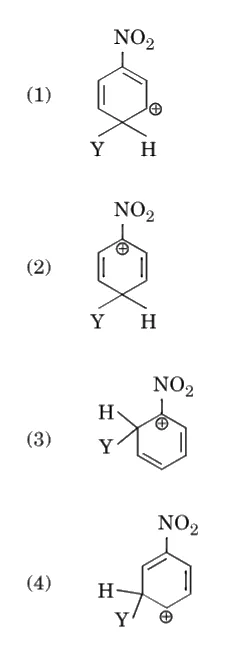 A[Diagram showing NO₂ group attached to benzene ring with carbocation and Y group]B[Diagram showing NO₂ group attached to benzene ring with carbocation at different position and Y group]C[Diagram showing NO₂ group attached to benzene ring with carbocation and Y group]D[Diagram showing NO₂ group attached to benzene ring with carbocation and Y group]
 - Q153.Chemistry
Which of the following is correct with respect to the effect of the substituents? ()
ABCD - Q154.Chemistry
In the reaction
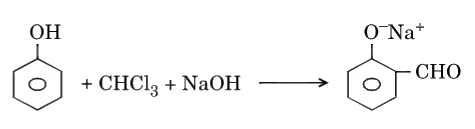
the electrophile involved is
Adichloromethyl cation ()Bformyl cation ()Cdichlorocarbene ()Ddichloromethyl anion () - Q155.Chemistry
Carboxylic acids have higher boiling points than aldehydes, ketones and even alcohols of comparable molecular mass. It is due to their
Aformation of intramolecular H-bondingBformation of carboxylate ionCformation of intermolecular H-bondingDmore extensive association of carboxylic acid via van der Waals force of attraction - Q156.Chemistry
Compound A, , is found to react with NaOI (produced by reacting Y with NaOH) and yields a yellow precipitate with characteristic smell.
A and Y are respectively
A andB andC andD and - Q157.Chemistry
Identify the major products P, Q and R in the following sequence of reactions:
AP = with benzene ring; Q = on benzene; R =BP = with benzene ring; Q = on benzene; R = on benzeneCP = on benzene; Q = on benzene; R =DP = on benzene; Q = on benzene; R = - Q158.Chemistry
Which of the following compounds can form a zwitterion?
AAnilineBAcetanilideCGlycineDBenzoic acid - Q159.Chemistry
For the redox reaction
the correct coefficients of the reactants for the balanced equation are
A16, 5, 2B2, 5, 16C5, 16, 2D2, 16, 5 - Q160.Chemistry
Which one of the following conditions will favour maximum formation of the product in the reaction,
ALow temperature and high pressureBLow temperature and low pressureCHigh temperature and low pressureDHigh temperature and high pressure - Q161.Chemistry
When initial concentration of the reactant is doubled, the half-life period of a zero order reaction
Ais halvedBis doubledCremains unchangedDis tripled - Q162.Chemistry
The correction factor '' to the ideal gas equation corresponds to
Adensity of the gas moleculesBvolume of the gas moleculesCforces of attraction between the gas moleculesDelectric field present between the gas molecules - Q163.Chemistry
The bond dissociation energies of X₂, Y₂ and XY are in the ratio of 1 : 0·5 : 1. ΔH for the formation of XY is – 200 kJ mol⁻¹. The bond dissociation energy of X₂ will be
A200 kJ mol⁻¹B100 kJ mol⁻¹C400 kJ mol⁻¹D800 kJ mol⁻¹ - Q164.Chemistry
Magnesium reacts with an element (X) to form an ionic compound. If the ground state electronic configuration of (X) is , the simplest formula for this compound is
AMg₂X₃BMgX₂CMg₃X₂DMg₂X - Q165.Chemistry
Iron exhibits bcc structure at room temperature. Above 900°C, it transforms to fcc structure. The ratio of density of iron at room temperature to that at 900°C (assuming molar mass and atomic radii of iron remains constant with temperature) is
ABCD - Q166.Chemistry
Consider the following species: CN⁺, CN⁻, NO and CN
Which one of these will have the highest bond order?
ANOBCN⁻CCNDCN⁺ - Q167.Chemistry
Which one is a wrong statement?
ATotal orbital angular momentum of electron in 's' orbital is equal to zero.BAn orbital is designated by three quantum numbers while an electron in an atom is designated by four quantum numbers.CThe value of m for is zero.DThe electronic configuration of N atom is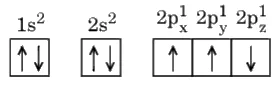
- Q168.Chemistry
The correct difference between first- and second-order reactions is that
Athe rate of a first-order reaction does not depend on reactant concentrations; the rate of a second-order reaction does depend on reactant concentrationsBthe half-life of a first-order reaction does not depend on [A]₀; the half-life of a second-order reaction does depend on [A]₀Cthe rate of a first-order reaction does depend on reactant concentrations; the rate of a second-order reaction does not depend on reactant concentrationsDa first-order reaction can be catalyzed; a second-order reaction cannot be catalyzed - Q169.Chemistry
In which case is the number of molecules of water maximum?
A18 mL of waterB0·18 g of waterC10⁻³ mol of waterD0·00224 L of water vapours at 1 atm and 273 K - Q170.Chemistry
Among CaH₂, BeH₂, BaH₂, the order of ionic character is
ABeH₂ < CaH₂ < BaH₂BCaH₂ < BeH₂ < BaH₂CBaH₂ < BeH₂ < CaH₂DBeH₂ < BaH₂ < CaH₂ - Q171.Chemistry
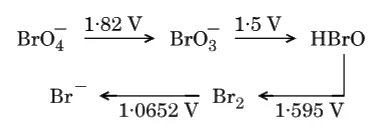
Consider the change in oxidation state of Bromine corresponding to different emf values as shown in the diagram below:
[Diagram: Shows redox potential diagram with species and E° values]
Then the species undergoing disproportionation is
 ABCD
ABCD - Q172.Chemistry
The solubility of BaSO₄ in water is at 298 K. The value of its solubility product (Ksp) will be
(Given molar mass of BaSO₄ = 233 g mol⁻¹)
ABCD - Q173.Chemistry
Following solutions were prepared by mixing different volumes of NaOH and HCl of different concentrations:
a. 60 mL HCl + 40 mL NaOH
b. 55 mL HCl + 45 mL NaOH
c. 75 mL HCl + 25 mL NaOH
d. 100 mL HCl + 100 mL NaOH
pH of which one of them will be equal to 1?
AbBaCcDd - Q174.Chemistry
On which of the following properties does the coagulating power of an ion depend?
AThe magnitude of the charge on the ion aloneBSize of the ion aloneCThe sign of charge on the ion aloneDBoth magnitude and sign of the charge on the ion - Q175.Chemistry
Given van der Waals constant for NH₃, H₂, O₂ and CO₂ are respectively 4·17, 0·244, 1·36 and 3·59, which one of the following gases is most easily liquefied?
ANH₃BH₂CCO₂DO₂ - Q176.Chemistry
Iron carbonyl, Fe(CO)₅ is
AtetranuclearBmononuclearCdinuclearDtrinuclear - Q177.Chemistry
The type of isomerism shown by the complex [CoCl₂(en)₂] is
AGeometrical isomerismBCoordination isomerismCLinkage isomerismDIonization isomerism - Q178.Chemistry
Which one of the following ions exhibits d-d transition and paramagnetism as well?
ABCD - Q179.Chemistry
The geometry and magnetic behaviour of the complex [Ni(CO)₄] are
Asquare planar geometry and diamagneticBtetrahedral geometry and diamagneticCtetrahedral geometry and paramagneticDsquare planar geometry and paramagnetic - Q180.Chemistry
Match the metal ions given in Column I with the spin magnetic moments of the ions given in Column II and assign the correct code:
Column I: Co³⁺, Cr³⁺, Fe³⁺, Ni²⁺
Column II: (i) B.M., (ii) B.M., (iii) B.M., (iv) B.M., (v) B.M.
Aiv, v, ii, iBi, ii, iii, ivCiii, v, i, iiDiv, i, ii, iii
Want the full paper with answer key?
Download the complete NEET 2018 Question Paper with Solutions PDF as a clean, printable PDF — free.
Download PDFMore NEET question papers
View all NEETpapers →More than just a PDF - all free with this paper
Full PDF download
Complete paper with answer key, print-ready.
Online practice
Instant answer + step-by-step solution.
Topic weightage
See which topics appear most and prepare smarter.
Frequently asked questions
How can I download the NEET 2018 Question Paper with Solutions PDF PDF?
Click the "Download PDF" button on this page to get the complete NEET 2018 Question Paper with Solutions PDF for free. The PDF comes with the answer key in a clean, print-ready format.
Can I practise the NEET 2018 paper online?
Yes. You can practise all 180 questions online for free on this page - each question shows the instant answer and a step-by-step solution.
Which topics are most important in NEET?
iGET provides a topic weightage analysis for NEET that shows which topics are asked most often each year, so you can prepare smarter.