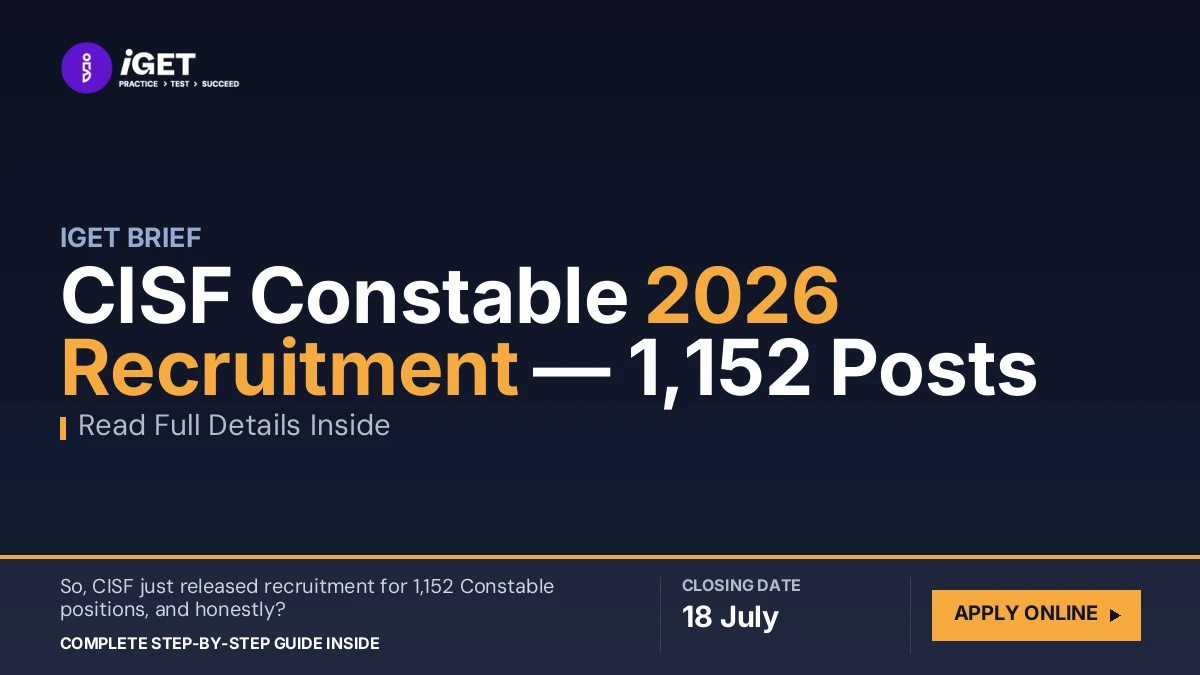
So, CISF just released recruitment for 1,152 Constable positions, and honestly? This is one of the better defence opportunities that's dropped this year. The application window closes on 18 July 2026, which gives you roughly three weeks to get your act together.
Here's the real talk — if you're even slightly interested in a defence career, this notification shouldn't slip through your fingers. These jobs come with solid job security, decent salary, and the kind of respect that comes with wearing a uniform. But the competition will be fierce. Really fierce.
Let me walk you through everything you need to know about this CISF recruitment drive, from eligibility to the actual application process.
What Is CISF and Why Should You Care?
Central Industrial Security Force (CISF) is a paramilitary force under the Ministry of Home Affairs. They protect key industrial installations, airports, and sensitive government facilities across India. Think nuclear plants, major ports, and high-security zones — CISF is the backbone behind their safety.
Working as a Constable in CISF isn't just another government job. You're part of an elite force with a mission. The job comes with steady pay, pension benefits, free medical care, and job security that's honestly hard to find anywhere else in the private sector.
Plus — and this matters to a lot of people — there's genuine career progression. If you perform well, you can move up the ranks. We're talking promotions, leadership opportunities, and the chance to genuinely impact national security.
Quick Facts About the CISF 2026 Constable Recruitment
| Total Posts | 1,152 Constable positions |
| Application Deadline | 18 July 2026 |
| Post Name | Constable (General Duty) |
| Age Limit | 18 to 23 years (as on application date) |
| Selection Process | Physical Test, Written Exam, Medical Check |
| Salary | ₹21,700 - ₹69,100 (approx., with allowances) |
Eligibility Criteria — Do You Qualify?
Before you even think about applying, you've got to tick all these boxes. CISF isn't flexible on this stuff.
Citizenship
You must be an Indian citizen. Full stop. No exceptions, no workarounds. If you're an OCI (Overseas Citizen of India), you're not eligible for this particular recruitment.
Age Requirement
The age bracket is 18 to 23 years, calculated as on the application closing date (18 July 2026). So if you were born between 18 July 2003 and 18 July 2008, you're in the window. There are standard age relaxations for SC/ST/OBC candidates — typically 5 years for OBC and up to 10 years for SC/ST, but always check the official notification because these can vary.
Educational Qualification
You need at least 10th pass (Secondary Education). That's it. No need for a college degree or anything fancy. This is actually one of the reasons why CISF recruitment attracts so many applicants — the barrier to entry is relatively low, but the competition is high.
Physical Standards
This is where it gets real. CISF has strict physical fitness requirements:
- Height: Minimum 165 cm for male candidates (some relaxation for SC/ST)
- Chest: Minimum 81 cm (expandable to 86 cm)
- Eyesight: 6/6 in both eyes (correctable to 6/6 with glasses)
These aren't just numbers on paper. You'll need to demonstrate these standards during the physical test phase. Bhai, real talk — if you're not already somewhat fit, start working on it now. The physical test is no joke.
Medical Fitness
You need to be medically sound with no chronic illness or disability. They'll conduct a full medical examination before final selection.
The Selection Process Explained
CISF Constable selection isn't a single test-and-done scenario. It's a multi-stage process designed to weed out candidates at each level. Here's how it works:
Stage 1: Physical Efficiency Test (PET)
This happens first. You'll be evaluated on:
- 1600 meters run (8 minutes 40 seconds maximum for males)
- Long jump
- High jump
- Shot put
This is a qualifying round — you either pass or you don't. No marks, no scoring. You make the cutoff, you move forward. You don't, your candidature ends here.
Stage 2: Physical Standards Test (PST)
They'll measure your height, chest, and conduct basic physical measurements. Again, qualifying round. If you don't meet the standards, you're out.
Stage 3: Written Examination
This is where your actual preparation comes in. The written exam typically has 100 questions covering:
- General Knowledge (30 questions)
- Reasoning & Problem Solving (25 questions)
- Numerical Aptitude (20 questions)
- English Language (25 questions)
Duration: 90 minutes. There's negative marking — 0.25 marks deducted for each wrong answer. So guessing randomly isn't a strategy.
Stage 4: Medical Examination
Candidates who qualify the written test go through a comprehensive medical check-up. It's thorough — drug screening, vision tests, hearing, the works.
Stage 5: Final Document Verification
If you pass everything, you're called for document verification where they'll cross-check all your certificates and personal details.
How to Apply — Step by Step
The application process is online. Here's exactly what you need to do:
- Visit the official CISF website (cisf.gov.in) and look for the recruitment notification link
- Click on the application link — they usually provide a direct portal or redirect you to a recruitment website
- Register yourself with email and mobile number. Keep these safe; you'll need them for future reference
- Fill in the application form with accurate personal, educational, and physical details. Be careful here — any discrepancy will lead to rejection
- Upload required documents (10th mark sheet, ID proof, passport-sized photo). Ensure documents are in specified format and size
- Pay application fee (if applicable) — usually around ₹100-200. OBC/SC/ST candidates often get a fee waiver
- Submit and download the confirmation receipt — keep this safe throughout the selection process
The application deadline is 18 July 2026. Don't procrastinate on this. Server crashes happen, and they won't grant extensions.
Preparation Strategy — How to Actually Crack This
Okay, so you've applied. Now what? Here's how to approach your preparation:
For Physical Tests
Start immediately. Seriously. Don't wait. Join a gym or start running daily. The 1600-meter run is the biggest hurdle for most candidates. Work on your cardiovascular fitness. If running isn't your thing, mix it up with cycling, swimming, or badminton. Just build that stamina.
For jumping and shot put, YouTube has plenty of form guides. Bad technique will kill you faster than lack of strength.
For Written Exam
You need a structured approach here. General Knowledge and English are where most candidates struggle. Start with basic current affairs and general knowledge topics — pick up a newspaper daily, follow reputable news sources. For English, focus on reading comprehension and grammar basics.
For numerical aptitude, practice simple arithmetic and percentage problems. CISF doesn't ask advanced math. It's more about speed and accuracy.
Logical reasoning and problem-solving requires consistent practice. Take mock tests regularly. Start 2-3 months before the exam.
Important Dates You Can't Afford to Miss
- Application Deadline: 18 July 2026
- Admit Card Release: Expected 3-4 weeks after application closes (check official website)
- Physical Tests: Likely scheduled for August-September 2026
- Written Exam: Tentatively October-November 2026 (depends on PET results)
- Results: Expected January 2027 onwards
These are approximate timelines based on previous CISF recruitment patterns. Official dates will be announced later, so keep checking the website.
Common Mistakes Candidates Make (Don't Be One of Them)
From what I've seen coaching students, here are the blunders that derail otherwise capable candidates:
Ignoring the physical test. Some people think they can just show up on exam day and pass the running round. Nope. You need 3-4 months of serious training.
Filling the application with typos. Your name, date of birth, anything — if it doesn't match your documents exactly, you're disqualified. Copy-paste slowly and double-check everything.
Not reading the official notification completely. There are specific details in the notification about category reservations, cutoff marks, and document requirements. Missing one detail can cost you the entire opportunity.
Starting preparation too late. If you apply in July, don't expect to crack the exam in September. Give yourself proper time.
Salary and Benefits — What You're Actually Getting
As a CISF Constable, your salary structure looks like this (approximate, 2026 rates):
- Basic Pay: ₹21,700
- Dearness Allowance: Around ₹10,000-12,000 (varies quarterly)
- House Rent Allowance: ₹4,300-7,000 depending on city
- Other Allowances: Medical, uniform, transport — roughly ₹5,000-8,000
Total in-hand salary: Approximately ₹45,000-55,000 per month after taxes.
But it's not just salary. You get:
- Defined benefit pension (50% of average salary)
- Free medical care for you and your family
- Gratuity on retirement
- Leave encashment
- Residential quarters (in most postings)
For a 10th pass candidate, this is genuinely solid compensation and security.
Frequently Asked Questions
What's the minimum qualification needed for CISF Constable?
You need to have passed 10th standard or higher. There's no upper qualification limit, so if you're a graduate, you're still eligible. However, the recruitment is specifically for Constable (General Duty) positions, and overqualification won't give you special advantage in the exam itself.
Can I apply if I'm 23 years and 11 months old?
No. Age is calculated as on the application closing date (18 July 2026). If you're 24 by then, you're ineligible. CISF is strict on this. Check your exact date of birth against the cutoff.
What happens if I fail the physical test?
If you don't clear PET or PST, your candidature ends there. You won't get a chance to take the written exam. That's why physical preparation is just as critical as exam preparation.
Is there any fee waiver for SC/ST candidates?
Yes, SC/ST/OBC candidates typically get a fee waiver on the application fee. Check the official notification for exact details on fee structure and eligible categories for this specific recruitment.
How many times can I attempt this recruitment?
There's usually no limit on attempts as long as you meet the age criteria. However, each recruitment is separate. If you miss the 2026 deadline, you'll have to wait for the next recruitment notification.
What if my educational documents are from a regional board, not CBSE/ICSE?
No problem. CISF accepts certificates from any recognized education board. Your 10th mark sheet from any state or national board is valid. Just ensure it's an original or officially attested copy.
Now, here's the million-rupee question: Are you actually ready to commit to this? CISF recruitment requires dedication across three fronts — physical fitness, written exam preparation, and documentation accuracy. If you're half-hearted about it, don't waste your time. But if you're serious, the next few months could genuinely change your life.
Start today. Apply before 18 July. Prepare like you mean it. You've got this.
📌 Source: Information based on latest reports and official notifications as of 24 June 2026. For the most accurate and updated details, candidates are advised to visit the CISF Official Website & PIB India. iGET is a learning resource portal — we do not represent any official authority. Verify all dates, eligibility, and procedures from official sources before applying.