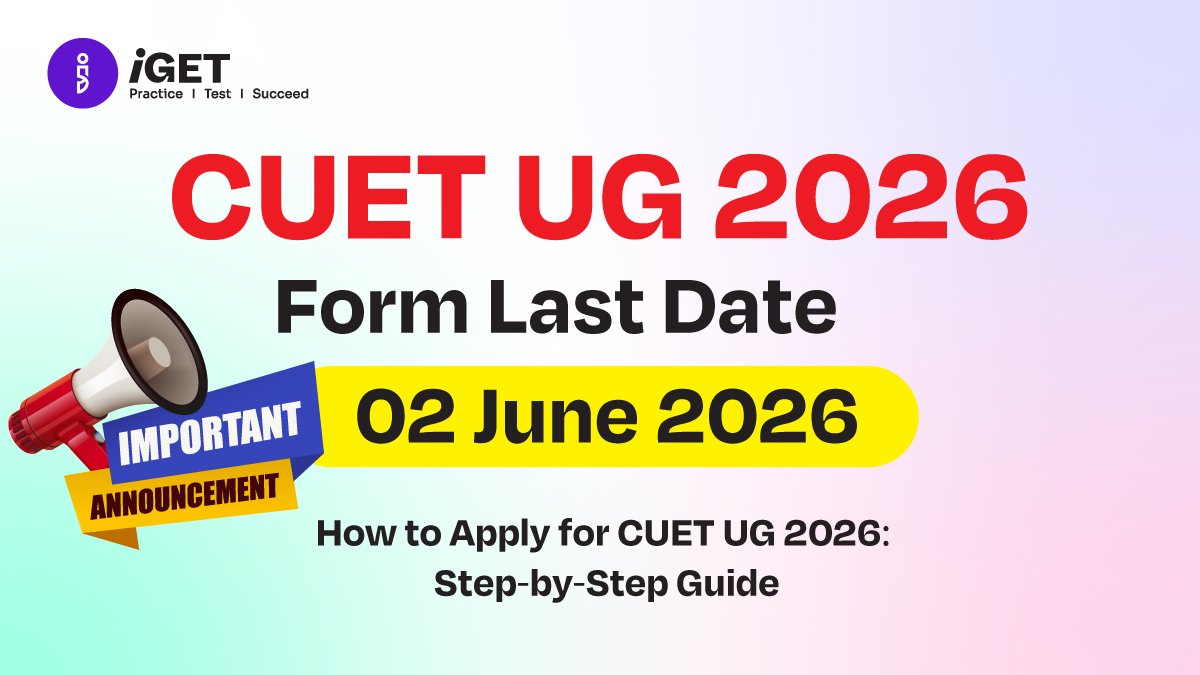
CUET UG 2026 application form last date is 02 June 2026. If you're targeting admission to central universities across India through the Common University Entrance Test, this is your final window to register. Missing this deadline means waiting another full year. This guide covers everything: eligibility criteria, step-by-step application process, exam schedule, syllabus breakdown, and proven preparation strategies to help you crack this competitive entrance exam.
What is CUET UG 2026? Quick Summary
The Common University Entrance Test (CUET) is a national-level entrance examination conducted by the National Testing Agency (NTA) for undergraduate admissions to central universities in India. As per the latest official notification, CUET UG 2026 is open to aspiring students seeking admission to undergraduate programs across 90+ participating central universities.
Unlike merit-based admissions of earlier years, CUET gives every student a fair, standardized platform to compete. Your marks in CUET 2026, combined with your class 12 score (40% weightage) and CUET marks (60% weightage), determine your final merit rank for university allocation.
Important Dates & Deadlines: Don't Miss Them
| Event | Date 2026 | Status |
| Application Form Release | 01 May 2026 | Live |
| Application Form Last Date | 02 June 2026 | Active |
| Admit Card Release | Mid-July 2026 (Expected) | Upcoming |
| Exam Dates | July-August 2026 (Expected) | Upcoming |
| Result Declaration | August-September 2026 (Expected) | Upcoming |
| Counselling & Seat Allocation | September 2026 onwards (Expected) | Upcoming |
Note: All dates are as per latest official announcements. Candidates are advised to regularly check the official NTA website for any updates or changes.
Key Dates Explained
- Application Window: You have exactly 32 days (01 May to 02 June 2026) to complete your registration. Plan your application early to avoid last-minute technical glitches.
- Late Fee Option: As per previous years' patterns, a late fee window may be available (typically 03-05 June), but this is not guaranteed. Don't bank on it.
- Admit Card: Download your admit card from the official portal at least 3-4 days before your exam date.
CUET UG 2026 Eligibility Criteria
Before you apply, ensure you meet all eligibility requirements. Meeting even one missing criterion can lead to rejection.
Basic Requirements
- Educational Qualification: You must have passed 10+2 (Class 12) or equivalent examination from any recognized board in India or abroad.
- Stream Flexibility: Unlike traditional entrance exams, CUET allows students from any stream (Science, Commerce, Arts, Vocational) to apply for any undergraduate program—provided they've studied the required subjects at 10+2 level.
- Age Limit: No upper age limit. Even working professionals and part-time learners can appear.
- Nationality: Indian nationals, NRIs, OCI card holders, and foreign nationals are eligible.
- Year of Passing: You must have passed class 12 in 2024, 2025, or 2026. Students appearing for class 12 in 2026 can also apply (provisional admission granted after passing).
Subject-Specific Eligibility
For certain professional programs (Engineering, Medicine, Law), you must have studied specific subjects at 10+2. For example:
- Engineering Programs: Physics + Mathematics mandatory (Chemistry preferred).
- Medical/Paramedical: Biology + Chemistry mandatory (Physics preferred).
- Law Programs: Any stream eligible; specific subjects not mandatory.
How to Apply for CUET UG 2026: Step-by-Step Guide
The application process is entirely online. Follow these steps carefully to ensure error-free registration:
- Visit Official Portal: Go to cuet.nta.ac.in (the only official registration website). Bookmark it to avoid phishing sites.
- Register as New User: Click "Register" and enter your email ID and mobile number. An OTP will be sent to both. Verify using OTP. Create a strong password (min 8 characters with uppercase, lowercase, number, and symbol).
- Login & Fill Application Form: Log in using your credentials. Fill personal details: name, date of birth, father's/mother's name, address, Aadhaar (optional but recommended), caste category, and disability status (if applicable).
- Select Programs & Universities: Choose up to 4 subject combinations based on your intended program. Example: if you want to study B.Sc (Physics, Chemistry, Mathematics), select this combination. You can select multiple combinations to keep options open.
- Upload Documents: Upload scanned copies (in JPG/PDF format, size <200 KB each):
- Passport-sized photograph (white background, face visible)
- High school (10th) mark sheet
- 12th board mark sheet (or scorecard)
- Class 12 admit card (if exam is ongoing)
- Aadhaar card (front & back)
- Caste certificate (if applicable)
- PwD certificate (if claiming disability quota)
- Select Exam Center & Language: Choose your preferred exam center from the list (availability based on your location). Select your exam language (English, Hindi, Assamese, Bengali, Gujarati, Kannada, Marathi, Malayalam, Odia, Punjabi, Tamil, Telugu, Urdu).
- Pay Application Fee: CUET 2026 application fee structure (as per expected notification):
- General/OBC-NCL Candidates: ₹650
- SC/ST Candidates: ₹550
- PwD Candidates: ₹550
- Review & Submit: Carefully review all entered information. Any error after final submission cannot be corrected (except minor details). Click "Submit" to finalize. You'll receive a confirmation email with your application number (Application ID). Save this number—you'll need it to download admit card and check results.
- Download Confirmation Receipt: After successful submission, download and print the confirmation receipt. Store it safely.
Pro Tips for Error-Free Application
- Fill the form in a single session to avoid timeout issues. Don't close the browser in between.
- Use your full name exactly as it appears in your 10th and 12th mark sheets. Discrepancies can lead to rejection.
- Upload clear, legible documents. Blurry or incomplete documents may lead to cancellation.
- Double-check your email ID and mobile number before submitting. You'll receive all future updates and admit card links here.
- If possible, apply by 30 May 2026—don't wait until 02 June to avoid server congestion.
CUET UG 2026 Exam Pattern & Structure
Understanding the exam pattern helps you strategize your preparation. CUET 2026 is a computer-based test (CBT) with multiple-choice questions (MCQs).
Test Format Overview
- Mode: Computer-Based Test (CBT) / Online
- Duration: 45 minutes per subject (no combined duration; subjects are tested separately across 2-3 days)
- Question Type: Multiple-choice questions (MCQs) with 4 options each
- Total Sections: Two main sections:
- Section A – Common for All: General Test (GK, Current Affairs, Reasoning) – 50 questions, 45 minutes
- Section B – Domain-Specific: Your chosen subject combination (typically 3-4 subjects, 40-50 questions each per subject)
- Marking Scheme:
- Correct answer: +5 marks
- Wrong answer: -1 mark (negative marking)
- Unanswered: 0 marks
- Total Marks: 300-400 (varies by subject combination chosen)
Subject Combinations Available
CUET offers diverse combinations. Popular ones include:
- Science: Physics + Chemistry + Biology, Physics + Chemistry + Mathematics, Mathematics + Biology + Psychology
- Commerce: Accounting + Business Studies + Economics, Accounting + Business Studies + Entrepreneurship
- Humanities: History + Political Science + Geography, English + History + Philosophy, Sociology + Political Science + History
- Professional Programs: Engineering (Physics + Math mandatory), Law, Medical/Paramedical
CUET UG 2026 Syllabus & Subject Topics
The CUET syllabus is primarily based on your 10+2 board curriculum (NCERT books are recommended). Here's a high-level breakdown:
General Test (Common for All)
- General Knowledge: Static GK (geography, polity, history, science), Current Affairs (6 months)
- Current Affairs & Reasoning: Logical sequences, analogies, direction sense, data interpretation
- Languages (if selected): Reading comprehension, synonyms, antonyms, sentence completion, error detection
Domain Subjects (Sample Topics)
- Physics: Mechanics, Thermodynamics, Waves, Electromagnetism, Modern Physics (Class 11-12 NCERT)
- Chemistry: Organic, Inorganic, Physical Chemistry, Periodic Table, Chemical Bonding (Class 11-12 NCERT)
- Mathematics: Algebra, Calculus, Trigonometry, Geometry, Statistics, Probability (Class 11-12 NCERT)
- Biology: Botany (photosynthesis, genetics, plant physiology), Zoology (human anatomy, ecology, evolution)
- English: Literary texts, poetry analysis, essays, comprehension, grammar, writing skills
- History: Ancient, Medieval, Modern India + World history (post-NCERT standard)
- Economics: Microeconomics, Macroeconomics, Indian economy, international trade
- Political Science: Indian Constitution, governance, international relations, political theory
Official Syllabus Download: Detailed syllabus PDFs for each subject are available on the official NTA website. Download and cross-check with your board's curriculum.
CUET UG 2026 Preparation Strategy & Tips
With 30-40 days left until the exam (expected in July-August), here's how to prepare strategically:
Month-by-Month Prep Timeline
- June 2026 (Post-Application): Complete the NCERT chapters you haven't finished. Focus on building conceptual clarity. Solve 3-5 questions per topic daily. Take one full-length mock test weekly.
- July 2026 (Pre-Exam): Shift focus to speed and accuracy. Take 3-4 mock tests per week. Analyze mistakes—create an error log to avoid repeating them. Revise high-weightage topics. Practice time management: aim to finish 40 questions in 40 minutes.
- August 2026 (Final Week): Light revision only. Avoid learning new topics. Take at least one full mock test under exam conditions (early morning, 45-minute timer, without breaks). Sleep well; exam fitness matters as much as knowledge.
Preparation Best Practices
- Foundation First: Spend 60% of your time on NCERT. Don't jump to advanced books until you've mastered board-level content.
- Active Learning: Don't just read; make notes, draw diagrams, create mind maps. This engages your brain and improves retention by 50%.
- Regular Mock Tests: Take CUET mock tests online. MockBanks like NTA's official practice portal offer free and paid mock series. Analyze every mock: identify weak areas, study those topics, and retake a similar mock after 3 days.
- Negative Marking Strategy: With -1 for wrong answers, avoid guessing randomly. If you can eliminate 2 out of 4 options, attempt. Otherwise, skip and move ahead.
- Time Allocation: Allocate your 45 minutes: 35 minutes for answering (using a rough pace of 1 min per question), 10 minutes for review and rechecking. Don't exceed 1.5 minutes per question on first pass.
- Subject Balance: If you're weak in one subject, dedicate 60% of daily study time to it (while maintaining 40% on other subjects). Weakness compounds, so fix gaps early.
Resources Recommended
- Free Resources: CUET preparation materials, NCERT PDFs, YouTube channels by top CUET coaches, official NTA sample papers
- Paid Resources (if budget allows): Online coaching (not necessary if you're self-disciplined), premium mock test series, previous year question books
- Revision Material: Formula sheets, shortcut tricks, flashcards for GK and language sections
Salary, Career & Higher Education Prospects After CUET
CUET admission opens doors to central universities like Delhi University, Jawaharlal Nehru University (JNU), University of Mumbai, IIT-BHU, and others. Your career trajectory depends on your program choice:
Career Outcomes by Stream
- Science Graduates: Research, engineering, medicine, competitive exams (IAS, UPSC), IT sector. Average package: ₹6-12 LPA in core sectors, ₹8-15 LPA in IT.
- Commerce Graduates: Chartered Accountancy (CA), Company Secretaryship (CS), banking, finance, corporate jobs. Average package: ₹6-10 LPA, reaching ₹15-20 LPA for CA/CS professionals.
- Arts Graduates: Civil services (UPSC IAS), journalism, law (after LLB), teaching, public administration. Average package: ₹6-10 LPA in government roles, ₹8-12 LPA in private sector.
- Professional Programs (Law/Engineering via CUET): Direct placement in top companies, higher starting packages (₹10-20 LPA).
Further Education Options
A central university degree is respected for pursuing:
- Postgraduate degrees (M.A., M.Sc., M.Com, MBA)
- Professional courses (CA, CS, Actuarial Science, etc.)
- Government exams (UPSC IAS, SSC, RBI, etc.)
- Foreign higher education (MS/PhD abroad)
Frequently Asked Questions
What is CUET UG, and who should take it?
CUET (Common University Entrance Test) is a standardized entrance exam for undergraduate admissions to 90+ central universities in India. Any student who has completed or is appearing for class 12 should take it if they plan to pursue higher education in central universities. Unlike board-merit based admissions, CUET ensures a level playing field for students across all states and boards.
When is the CUET UG 2026 application form last date?
The CUET UG 2026 application form last date is 02 June 2026. Applications submitted after this date will not be accepted (unless a late fee window is officially announced, which is uncertain). Apply early to avoid technical issues. You have until 02 June 2026 to complete registration, upload documents, and pay fees.
Who is eligible to apply for CUET UG 2026?
Any student who has passed or is appearing for class 12 from a recognized board is eligible. There's no age limit. Indians, NRIs, OCI cardholders, and foreign nationals can apply. However, specific programs (Engineering, Medical) require certain subjects at 10+2 (e.g., Physics + Math for Engineering, Biology + Chemistry for Medicine).
What is the CUET application fee for 2026?
Expected application fee: ₹650 for General/OBC-NCL candidates, ₹550 for SC/ST/PwD candidates. Payment is via online modes (debit/credit card, net banking, UPI). No refund is offered once paid. Fee structure may change; check the official notification before paying.
What is the CUET 2026 exam date and pattern?
Exam dates are expected in July-August 2026 (exact dates will be announced on the official website). The exam is a computer-based test (CBT). Each subject lasts 45 minutes. You'll answer multiple-choice questions (MCQs). Marking: +5 for correct, -1 for wrong, 0 for unanswered. Total marks vary (300-400) based on your subject combination.
How do I prepare for CUET in 30-40 days?
Focus on NCERT first (foundation). Take mock tests weekly to identify weak areas. Study those areas intensively. Practice time management: aim to finish 40 questions in 40 minutes. Revise regularly. Avoid learning new topics in the final week. Sleep 7-8 hours daily. Use error logs to track and avoid repeated mistakes. Use resources like official NTA sample papers and online coaching if needed.
Final Takeaway
CUET UG 2026 is your gateway to India's premier central universities. With the application deadline on 02 June 2026 just weeks away, don't procrastinate. Complete your application now, finalize your subject choices, and start structured preparation immediately. The exam, expected in July-August, will test your class 12 knowledge and general aptitude. With a balanced study plan, mock test practice, and focused revision, you can score 200+ out of 300-400 marks and secure admission to your dream university. Remember: consistency beats intensity. Study smartly, not just hard. Good luck!
📌 Source: Information based on latest reports and official notifications as of 03 May 2026. For the most accurate and updated details, candidates are advised to visit the National Testing Agency (NTA). iGET is a learning resource portal — we do not represent any official authority. Verify all dates, eligibility, and procedures from official sources before applying.