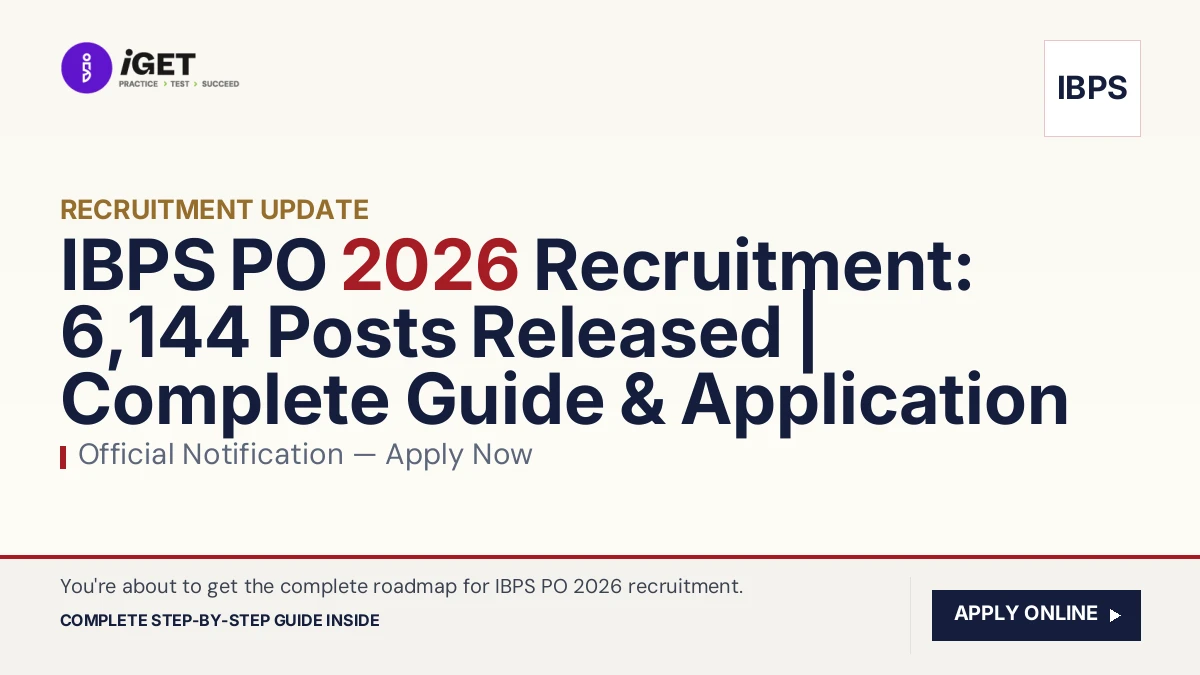
You're about to get the complete roadmap for IBPS PO 2026 recruitment. By the end of reading this, you'll know exactly what you need to do to apply, when the exam happens, and how to prepare — no confusion, no wasted time.
Here's the big news: IBPS has released the notification for 6,144 Probationary Officer (PO) positions. That's a solid number. And the last date to submit your application is 18 June 2026. That gives you roughly 12 days from today. So if you're serious about this, you need to move fast.
What's This IBPS PO 2026 Recruitment All About?
Let me break it down simply. IBPS — Institute of Banking Personnel Selection — conducts recruitment for multiple public sector banks across India. This year, they're hiring 6,144 Probationary Officers. These are entry-level management positions in banks, and honestly, they're one of the most sought-after jobs in India's banking sector.
The positions are spread across various participating banks like State Bank of India, Punjab National Bank, Bank of Baroda, and others. You don't apply to a specific bank — you apply through IBPS, and after selection, you get allocated to a bank based on your choice and performance.
Why does this matter? Because PO roles come with decent salary packages (around ₹30,000-₹37,000 basic, plus allowances), job security, and solid career growth. Not to mention the government job status. If you've been thinking about switching from the private sector or this is your first real opportunity, IBPS PO is worth serious consideration.
Eligibility Criteria: Check If You Qualify
Before you get excited and start filling the form, let's make sure you actually meet the basic requirements. No point wasting time if you don't qualify, yeah?
Here's what IBPS needs from you:
- Nationality: You must be an Indian citizen (or hold OCI/PIO status)
- Age Limit: Between 20-30 years as on 1 June 2026. This is crucial — age relaxation applies for SC/ST/OBC candidates (5 years extra) and for certain reserved categories.
- Educational Qualification: Bachelor's degree from a recognized university in ANY discipline. That's it. They don't care if you studied history or physics — just have the degree.
- Language Proficiency: You should be able to read, write, and speak English and the official language of the state where you'll be posted. This isn't tested in the exam, but you need it for the job.
Real talk: the age limit is the trickiest part. A lot of candidates miss the cutoff by a few months. Check your exact date of birth against the official notification on the IBPS website. If you're borderline on age, calculate your relaxation eligibility based on your category.
Application Fee & How to Apply Online
Let's talk money first. The application fee is ₹850 for the general category and ₹175 for SC/ST/PWD candidates. You can pay through debit card, credit card, or net banking. There's no fee waiver, so plan accordingly.
Now, applying is straightforward if you follow these steps:
- Go to the official IBPS website — ibps.in. Bookmark this. You'll visit it multiple times.
- Click on "Apply Online" — you'll see the link clearly on the homepage once the notification goes live.
- Read the instructions carefully — I know it sounds boring, but IBPS notifications have specific details about document uploads, file sizes, and formats. Missing one detail can get your application rejected.
- Register yourself — create a login ID using your email and phone number. Keep these credentials safe; you'll need them for downloading admit cards and checking results.
- Fill the application form — your personal details, educational qualifications, work experience (if any), and preferred posting location (choice of states/cities).
- Upload scanned documents — typically: passport-size photo (4x6 cm, white background), signature, and relevant educational/caste certificates. File size limit is usually 100 KB per image.
- Pay the fee online — submit payment and get a confirmation receipt.
- Print your application copy — save the acknowledgment PDF. You'll need this for future correspondence.
Pro tip: Apply early. I've seen servers crash close to the deadline, and trust me, "the website wasn't working" doesn't fly with IBPS. Better to apply on day one of the window rather than on day 11.
Important Dates You Can't Afford to Miss
| Event | Date |
| Notification Released | 6 June 2026 |
| Online Application Window Opens | 6 June 2026 |
| Last Date to Apply | 18 June 2026 |
| Admit Card Release | Expected: Mid-July 2026 |
| Preliminary Exam | Expected: Late July/August 2026 |
| Main Exam | Expected: September 2026 |
| Interview | Expected: October-November 2026 |
Mark the 18 June deadline in your calendar right now. And set a reminder for at least two days before — not on the last day itself. Trust me on this.
Exam Pattern & Syllabus Overview
So you've applied. Now what? You need to understand what you're actually preparing for.
The IBPS PO exam has two main rounds:
Preliminary Exam (Qualifying round):
- 3 sections: Reasoning Ability, Quantitative Aptitude, English Language
- 100 questions in 60 minutes
- Each section has separate time limits
- Negative marking: 0.25 marks per wrong answer
Main Exam (Merit-based):
- 4 sections: Reasoning & Computer Aptitude, Data Analysis & Interpretation, General/Financial Awareness, English Language
- 190 questions in 180 minutes (3 hours)
- Separate sectional cutoffs apply
- This score decides your interview call
After the main exam, selected candidates go through a personal interview (100 marks) and document verification. Your final merit list is based on: Main exam score (80%) + Interview performance (20%).
The syllabus? Standard banking exam fare. You'll cover topics like:
- Quantitative Aptitude: Number systems, percentage, time & work, compound interest, partnerships, profit & loss
- Reasoning: Coding-decoding, seating arrangements, blood relations, logical sequences
- English: Reading comprehension, grammar, vocabulary, cloze tests
- General Awareness: Current events, banking terminology, government schemes, economic news from the last 6 months
- Computer Knowledge: Basic hardware/software, cybersecurity, MS Office basics
Honestly? The exam is designed for graduates with decent aptitude and decent preparation. It's not a UPSC level beast, but it's not a breeze either. You typically need 60-70% marks to clear the preliminary and get interview calls, depending on category and difficulty level.
Preparation Strategy: What Actually Works
Here's the thing most students get wrong: they start preparing without a plan. They chase YouTube videos and random mock tests. That doesn't work.
You need a structured approach. With about 2-3 months before the preliminary exam, here's what you should do:
Phase 1 (Weeks 1-3): Foundation Building
Go back to basics. If your English grammar is shaky, fix it now. If you haven't touched percentages in years, rebuild that concept. Use your class notes or YouTube channels from your iGET banking preparation section for conceptual clarity. Don't jump to practice questions yet. Understand the fundamentals first.
Phase 2 (Weeks 4-7): Topic-wise Mastery
Now tackle each topic systematically. Take reasoning first — master coding-decoding in 3-4 days, then move to seating arrangements, and so on. Solve 20-30 quality questions per topic. Quality over quantity, always. One well-understood question teaches you more than 100 rushed ones.
Phase 3 (Weeks 8-9): Full-length Mock Tests
By now, you should attempt at least 8-10 full preliminary exam mock tests under timed conditions. This is where you build speed and accuracy together. Analyze every mock test. Figure out which sections drain your time. Adjust.
General Awareness is different though. Don't wait for phase 3. Read current affairs daily. Subscribe to an economic news letter, follow PIB updates, and maintain a notebook of banking/RBI-related news. By the time exam day comes, your awareness should be sharp.
Real talk: avoid last-minute cramming. Your brain doesn't absorb new concepts well under pressure. If you haven't studied a topic 3 weeks before the exam, it's too late to start.
Common Mistakes You Should Avoid
I've seen hundreds of IBPS aspirants stumble. Here are the mistakes that could cost you:
- Applying too late: Don't wait until 17 June. Servers get overloaded, your payment might fail, or you might realize your documents aren't ready. Apply by 15 June at the latest.
- Wrong document uploads: If your photo is blurry, if your signature doesn't match later documents, if your caste certificate isn't valid — application gets rejected. Double-check everything before uploading.
- Underestimating General Awareness: Students often focus only on quant and reasoning. But GA sections in the main exam carry substantial weightage. Ignore it and you'll regret it.
- Not practicing with real exam patterns: IBPS changes exam patterns occasionally. Use the mock tests from the official IBPS website or trusted coaching platforms. Random tests from sketchy websites won't prepare you correctly.
- Ignoring sectional cutoffs: You might score 65% overall but fall short in one section. Sectional cutoffs are strict. Ensure balanced preparation across all subjects.
- Excessive course hopping: Pick one reliable study platform (iGET has solid banking prep content), stick with it, and complete it. Don't jump between five different courses — it fragments your learning.
Pro Tips for Success
Here's what separates candidates who crack this from those who don't:
1. Create a study schedule aligned with exam dates. Work backward from exam day. If the preliminary exam is expected in August, you have 6-7 weeks. That's 42 days. Plan 5-6 hours daily (or more if you can). Allocate time per section and per topic realistically.
2. Join a peer study group. Discussing reasoning problems, debating which answer is right, explaining concepts to friends — it sticks. Isolation kills motivation.
3. Track your mock test performance religiously. Create a spreadsheet. Track: date, overall score, sectional scores, time spent per section, mistakes made. Patterns will emerge. You'll see if you're weak in data interpretation or English reading comprehension. Fix weak areas specifically.
4. Practice speed and accuracy drills separately. Don't mix them. First, solve questions slowly and accurately. Build concept clarity. Then, gradually speed up. Never sacrifice accuracy for speed.
5. Read the official notification thoroughly. IBPS sometimes includes specific instructions — whether you can use calculators, specific dos and don'ts during the exam. Miss these and you could lose marks or get eliminated for rule violation.
6. Stay updated on exam changes. IBPS occasionally tweaks the exam format or adds new sections (like computer aptitude in the main exam, which is relatively new). Follow the official IBPS portal and credible banking exam websites regularly.
Frequently Asked Questions
What is the last date to apply for IBPS PO 2026?
The last date to submit your online application is 18 June 2026. Applications submitted after midnight on 18 June won't be accepted. Given server overload possibilities, apply by 15-16 June to be safe. Waiting until the last moment is risky.
What is the age limit for IBPS PO 2026?
The upper age limit is 30 years as on 1 June 2026. If you were born after 1 June 1996, you're eligible. SC/ST candidates get 5 years relaxation, OBC gets 3 years. Check the official notification for your specific category's eligibility.
How much is the application fee for IBPS PO 2026?
General and OBC candidates pay ₹850. SC/ST/PWD candidates pay ₹175. Payment is through online banking only. No offline payment or bank transfer is accepted. The fee is non-refundable.
What documents do I need to upload during application?
You'll need a recent passport-size photograph (white background, 4x6 cm), your signature, and relevant documents like educational certificates, caste certificate (if applicable), and any other qualifying credentials. Check the detailed notification for exact specifications.
When is the IBPS PO 2026 exam expected to be held?
Based on previous years' patterns, the preliminary exam is expected in late July or August 2026, and the main exam in September 2026. The official exam date will be announced in the admit card, which typically releases a month before the exam.
Is there any negative marking in IBPS PO exams?
Yes. In the preliminary exam, each wrong answer attracts a penalty of 0.25 marks. In the main exam, different sections have different negative marking (typically 0.25 marks per wrong answer in most sections). Unanswered questions carry zero marks — no penalty.
📌 Source: Information based on latest reports and official notifications as of 06 June 2026. For the most accurate and updated details, candidates are advised to visit the IBPS Official Website. iGET is a learning resource portal — we do not represent any official authority. Verify all dates, eligibility, and procedures from official sources before applying.