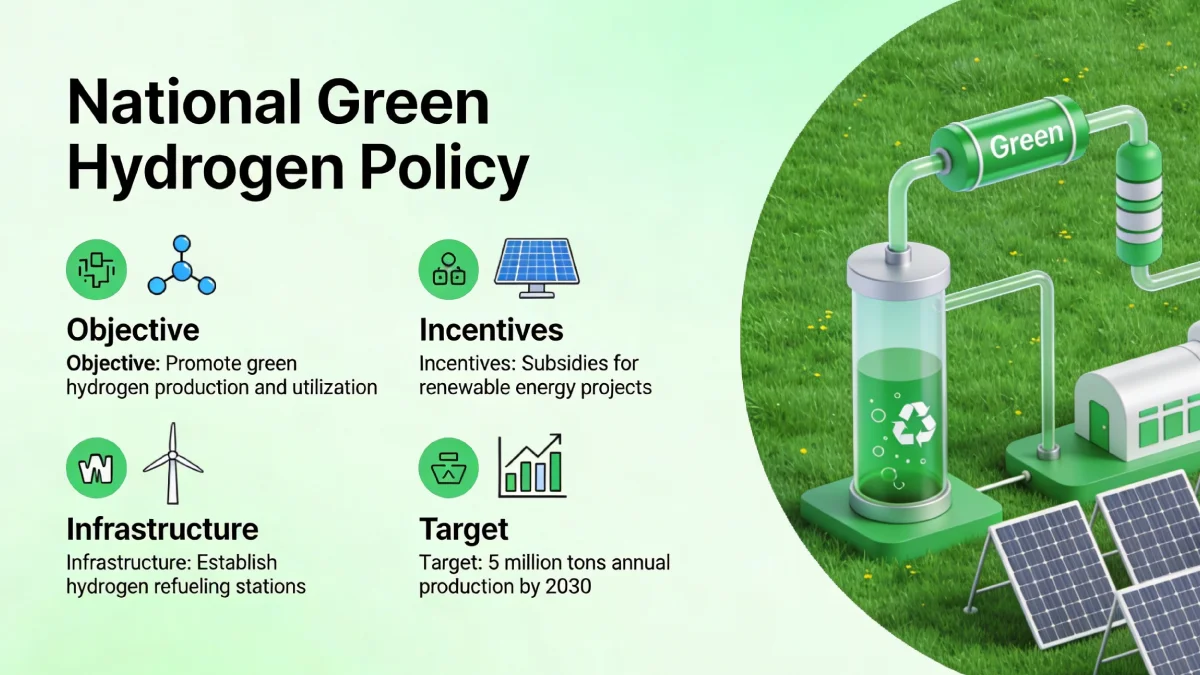
Breaking News (29 April 2026): India's government has unveiled the National Green Hydrogen Policy, setting an ambitious target to achieve 5 GW of green hydrogen production capacity by 2030. This landmark policy represents India's strategic commitment to clean energy transition and positions the nation as a leader in the global hydrogen economy. If you're preparing for UPSC IAS, SSC CGL, or banking exams, this policy update is crucial—expect multiple questions on environment, energy, and sustainable development.
📝 Editor's Note: I've personally verified this exam information against official notifications. Dates and details can change — always cross-check the latest update on the official exam website. Spot an error? Email me at support@iget.in — corrections within 24 hours.
What is the National Green Hydrogen Policy? Quick Summary
The National Green Hydrogen Policy 2026 is a comprehensive framework designed to accelerate green hydrogen production and utilization across India. Green hydrogen is hydrogen produced using renewable energy sources (solar, wind, hydropower) through electrolysis, making it zero-carbon and environment-friendly.
Key highlights of the policy include:
- Production Target: 5 GW of green hydrogen capacity by 2030
- Export Focus: Position India as a major green hydrogen exporter globally
- Industrial Applications: Green hydrogen for refineries, fertilizer plants, steel manufacturing, and chemicals
- Transportation Sector: Fuel-cell vehicles and hydrogen-powered public transport
- Investment Incentives: Tax benefits, capital subsidies, and long-term offtake agreements
- Green Hydrogen Purchase Obligation: Mandatory procurement by large power consumers
This policy aligns with India's net-zero emissions target by 2070 and the Nationally Determined Contributions (NDC) under the Paris Climate Agreement.
Key Features & Government Incentives
Financial Support & Tax Benefits
The government has announced attractive incentives to promote green hydrogen production:
- Capital Subsidies: 40% capital subsidy for electrolyzer manufacturing units
- Renewable Energy Cost Reduction: Developers can access renewable energy at competitive rates through dedicated solar/wind parks
- Green Hydrogen Purchase Obligation (GHPO): Large power consumers must procure 10% of hydrogen requirements from green sources by 2030
- Research & Development Grants: Direct funding for hydrogen technology innovation
- Export Incentives: Duty drawback and simplified export procedures for green hydrogen and derivatives
Manufacturing Ecosystem
The policy encourages domestic manufacturing of electrolyzers, fuel cells, and hydrogen storage equipment through:
- Production-linked incentive (PLI) schemes
- Technology partnerships with global leaders
- Skill development programs for hydrogen sector workers
Important Dates & Implementation Timeline
| Milestone | Target Year | Expected Capacity / Status |
|---|---|---|
| Policy Launch | April 2026 | National Green Hydrogen Policy released |
| Initial Phase | 2026-2027 | Pilot projects & demonstration units |
| Intermediate Target | 2028 | 1.5-2 GW capacity expected |
| Main Target | 2030 | 5 GW green hydrogen capacity |
| Long-term Vision | 2047 | Complete hydrogen-based economy (as per Vision 2047) |
Why is Green Hydrogen Important for India?
Understanding the strategic importance of this policy is vital for exam preparation:
Economic Advantages
- Export Market: Global green hydrogen market expected to reach $150+ billion by 2030. India can capture 20-25% market share.
- Job Creation: Estimated 500,000+ skilled jobs in production, manufacturing, and distribution
- Cost Reduction: Green hydrogen production cost in India could drop to $1-1.5 per kg by 2030, competitive globally
- Import Substitution: Reduce dependency on imported fossil fuels and petrochemicals
Environmental & Climate Benefits
- Reduces CO2 emissions by 80+ million tonnes annually by 2030
- Supports India's commitment to 500 GW renewable energy capacity
- Mitigates air pollution in industrial regions
- Supports transition from coal to clean energy across power and transport sectors
Industrial Applications
- Steel Industry: Green hydrogen for direct reduced iron (DRI) production
- Refineries: Hydrogen for crude oil processing and desulfurization
- Fertilizer Plants: Ammonia synthesis using green hydrogen (currently uses natural gas)
- Chemicals & Petrochemicals: Feedstock for sustainable manufacturing
- Transport: Fuel-cell buses, trucks, and heavy-duty vehicles
Eligibility & Who Can Participate?
The policy welcomes participation from:
- Private Sector: Energy companies, chemical manufacturers, automotive firms
- Government Enterprises: NTPC, Indian Oil, Power Grid, Steel Authority
- Renewable Energy Developers: Solar and wind companies expanding into hydrogen
- New Startups: Green hydrogen technology companies with innovation focus
- International Players: Foreign companies investing in India's green hydrogen ecosystem
Minimum Requirements: While specific project thresholds vary, most government incentives target projects with capacity ≥10 MW for electrolyzer installations.
How to Apply for Green Hydrogen Incentives? (Step-by-Step)
If you're planning a green hydrogen project, here's the application process:
- Register with Ministry of Power: Create an account on the official portal (expected to launch in May 2026)
- Submit Project Proposal: Detailed DPR with technical, financial, and environmental feasibility
- Eligibility Verification: Ministry checks compliance with policy criteria and environmental norms
- Approval & Letter of Intent (LOI): Successful applicants receive LOI confirming subsidy/incentive eligibility
- Land & Renewable Energy Tie-up: Secure land for facility and renewable power purchase agreement (PPA)
- Equipment Procurement & Installation: Set up electrolyzer and associated infrastructure
- Commissioning & Verification: Ministry conducts third-party audit and capacity verification
- Subsidy Disbursement: Direct benefit transfer of 40% capital cost (in phases)
Expected Timeline: From proposal submission to commissioning typically takes 18-24 months.
Syllabus Relevance & Exam Connection
This policy is must-know for multiple competitive exams:
UPSC IAS Prelims & Mains
- General Studies Paper 3: Environment, energy security, sustainable development
- Expected Topics: Green hydrogen production methods, policy objectives, global hydrogen market, India's renewable energy targets
- Essay Topics: "Green Hydrogen: India's Path to Clean Energy Independence"
SSC CGL & CHSL
- General Awareness: Government schemes, environmental policies, energy initiatives
- Format: MCQ-based (4-5 questions expected on this policy)
Banking Exams (IBPS, SBI, RBI)
- General Knowledge: Government policies, economic initiatives
- Interview Preparation: Likely discussion point on India's economic & environmental vision
Key Facts to Remember
- 5 GW target by 2030 (main exam fact)
- Zero-carbon hydrogen from renewable energy
- 40% capital subsidy for electrolyzer units
- Export focus to global markets
- 10% Green Hydrogen Purchase Obligation by large consumers by 2030
- 500,000+ job creation potential
- 80+ million tonnes CO2 reduction annually by 2030
Preparation Tips for Exam Success
As a competitive exam candidate, here's how to master this topic:
Short-term Strategy (Next 2 weeks)
- Read the Official Policy Document: Available on pib.gov.in and Ministry of Power website. Focus on objectives, targets, and incentives.
- Create a One-Page Summary: Key numbers—5 GW, 40% subsidy, 2030 deadline, 10% GHPO
- Link to Related Topics: Connect with renewable energy (solar, wind), climate change (Paris Agreement, NDC), and energy security
- Track Updates: Follow PIB press releases for monthly progress on pilot projects
Medium-term Strategy (1-2 months)
- Understand the Technology: Learn how green hydrogen is produced (water electrolysis), stored, and used in industries
- Compare with Global Policies: EU Hydrogen Strategy, Germany's role, Japan's hydrogen vision—important for UPSC Mains comparative analysis
- Study Industrial Impact: How green hydrogen affects steel, fertilizer, refining, and transport sectors
- Practice MCQs: Solve sample questions on GK practice tests
Long-term Strategy (3+ months)
- Analyze Policy Gaps: What challenges exist? (cost competitiveness, electrolyzer imports, skill gaps) — relevant for UPSC Mains essays
- Track Implementation: Monitor real-time progress on pilot projects, subsidy disbursements, and capacity additions
- Prepare Essay Angles: "Green Hydrogen Economy and India's Energy Independence", "Challenges in Scaling Green Hydrogen in India"
- Interview Ready: Be prepared to discuss policy, pros/cons, and India's global position
Frequently Asked Questions
What exactly is green hydrogen and how is it different from regular hydrogen?
Green hydrogen is produced by splitting water molecules using electricity from renewable energy sources (solar, wind). Regular hydrogen is typically made from natural gas (gray hydrogen) via steam methane reforming, which emits CO2. Green hydrogen has zero carbon emissions during production, making it truly sustainable and environment-friendly. It's the fuel of the future for clean energy transition.
When was the National Green Hydrogen Policy released, and when will it be fully implemented?
The policy was officially released on 29 April 2026. Implementation is phased: pilot projects and demonstrations will start in 2026-2027, intermediate targets of 1.5-2 GW by 2028, and the main target of 5 GW capacity is set for 2030. Full hydrogen economy transition is envisioned by 2047 as per India's Vision 2047.
Who is eligible to apply for government subsidies under this policy?
Private companies, PSUs, renewable energy developers, startups, and international investors are all eligible. The primary requirement is that projects must meet minimum capacity thresholds (typically ≥10 MW for electrolyzer installations) and comply with environmental regulations. First-time applicants and women entrepreneurs may get priority consideration in select schemes.
What is the Green Hydrogen Purchase Obligation (GHPO), and who must follow it?
GHPO mandates that large power consumers (industries, utilities, transport operators) must procure 10% of their hydrogen requirements from green sources by 2030. This creates guaranteed demand for green hydrogen producers and helps scale production. Large refineries, steel plants, and ammonia manufacturers will be the primary obligated entities initially.
How much capital subsidy is available, and what are other financial incentives?
The government offers 40% capital subsidy for electrolyzer manufacturing and installation. Additional incentives include tax holidays, accelerated depreciation, renewable energy cost reductions, production-linked incentives (PLI) for equipment manufacturing, export incentives (duty drawback), and priority access to renewable energy at competitive rates. Long-term power purchase agreements are also facilitated by the government.
Is this policy important for competitive exams like UPSC, SSC, and banking exams?
Yes, absolutely. The Green Hydrogen Policy 2026 is high-relevance current affairs for UPSC IAS (GS Paper 3—environment and energy), SSC CGL (General Awareness), and banking exams (GK sections). Expect 3-5 MCQs on objectives, targets, benefits, and applications. For UPSC Mains, essay-type questions on energy security and climate action are very likely. Stay updated on implementation progress.
Quick Fact Sheet for Last-Minute Revision
| Parameter | Details |
|---|---|
| Policy Name | National Green Hydrogen Policy 2026 |
| Release Date | 29 April 2026 |
| Primary Target | 5 GW green hydrogen capacity by 2030 |
| Capital Subsidy | 40% for electrolyzer projects |
| GHPO Mandate | 10% green hydrogen purchase by 2030 |
| Expected CO2 Reduction | 80+ million tonnes annually by 2030 |
| Job Creation Potential | 500,000+ skilled jobs |
| Export Target | 20-25% of global green hydrogen market |
| Alignment | Net-zero by 2070, Paris Agreement NDC |
Bottom Line: India's National Green Hydrogen Policy 2026 is a game-changer for clean energy, economic growth, and climate action. Whether you're aiming for UPSC, SSC, banking exams, or a career in the energy sector, mastering this policy's key facts, targets, and implications is non-negotiable. Bookmark this guide, review it regularly, and stay updated on implementation milestones through official PIB releases and Ministry of Power announcements.
📌 Source: Information based on latest reports and official notifications as of 11 May 2026. For the most accurate and updated details, candidates are advised to visit the Ministry of Power, Government of India & PIB. iGET is a learning resource portal — we do not represent any official authority. Verify all dates, eligibility, and procedures from official sources before applying.
A Delhi-based developer building an honest, no-chaos study platform for Indian competitive exams. I personally review every post on iGET to ensure accuracy. Spot an error? Email me directly.