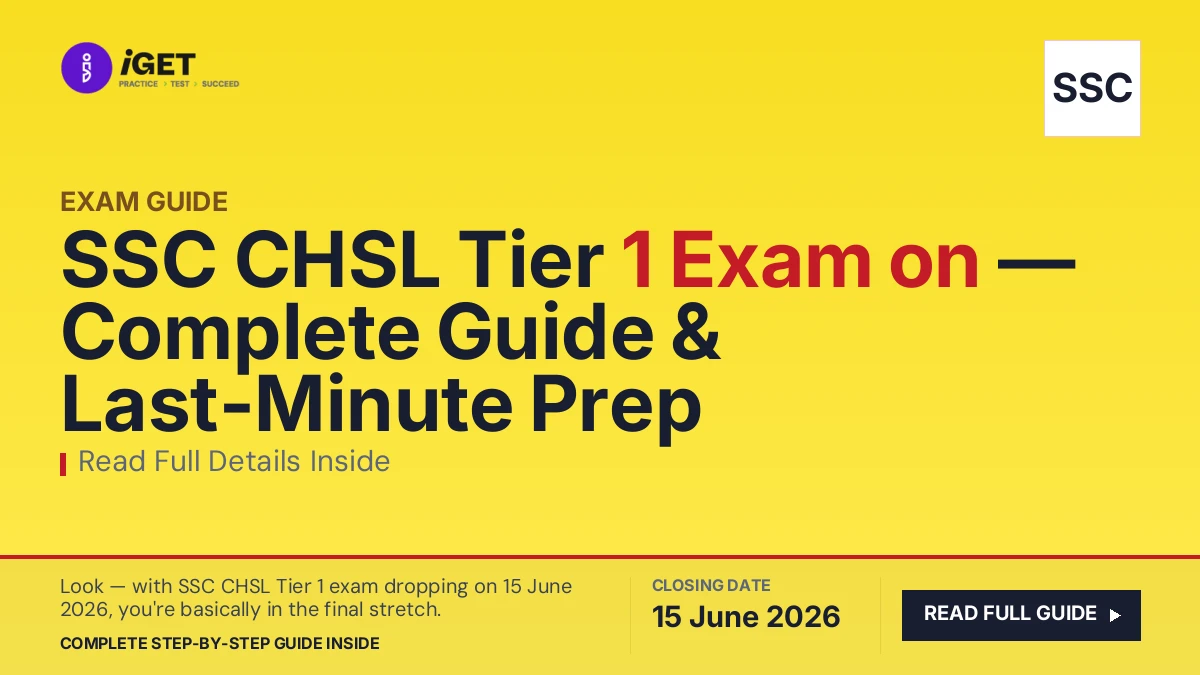
Look — with SSC CHSL Tier 1 exam dropping on 15 June 2026, you're basically in the final stretch. If you haven't already started intensive prep, this is your wake-up call. We're 12 days out, and honestly, the candidates who crush this exam aren't the ones with perfect study schedules. They're the ones who know exactly what to focus on in these last two weeks.
By the end of this guide, you'll know: the exact exam pattern, what chapters to prioritize, how to manage your time on exam day, and what mistakes almost every candidate makes (and how to avoid them).
What Exactly Is SSC CHSL 2026 Tier 1?
SSC CHSL stands for Combined Higher Secondary Level. It's basically the gateway exam for positions like Lower Divisional Clerk (LDC), Court Clerk, Data Entry Operator, and similar roles across Indian government offices. The Tier 1 exam? That's your first hurdle — it's a computer-based test that happens on 15 June 2026 (mark that date).
Here's what makes it tricky: you get 60 minutes to attempt 100 questions across four sections. That's less than 40 seconds per question. No buffer. No second chances. So speed AND accuracy matter equally.
Exam Pattern Breakdown — What You're Actually Facing
The Four Sections You Need to Know
The Tier 1 paper has four equal sections, each worth 25 marks:
- General Intelligence & Reasoning (25 marks) — Analogies, classifications, series, Venn diagrams, direction sense, coding-decoding. This section is pure pattern recognition. Most candidates fumble here because they try to "think too hard."
- General Awareness (25 marks) — Current events, Indian history, geography, science basics, polity. Basically, if it's in the news or textbooks, it's fair game.
- Quantitative Aptitude (25 marks) — Percentages, averages, profit-loss, time & work, geometry, algebra. The nightmare section for many. But it's actually the easiest to improve in 2 weeks.
- English Language (25 marks) — Reading comprehension, spelling, grammar, vocabulary, sentence improvement. Honestly, this separates the good scores from the great scores.
Total: 100 questions, 60 minutes, 200 marks (technically, since each question = 2 marks).
Oh, and there's a negative marking rule — 0.50 marks deducted for every wrong answer. So guessing randomly? Terrible idea.
Timeline & Key Dates — Don't Miss These
| Event | Date |
| Tier 1 Exam Date | 15 June 2026 |
| Admit Card Release | Expected 10-12 June 2026 |
| Admit Card Download Closes | Day of exam (15 June) |
| Exam Shift Timings | Likely 9 AM-10 AM & 11 AM-12 PM (2 shifts) |
Mark your calendar. Seriously. Missing your admit card download window is a rookie mistake we see every year.
12-Day Crash Prep Strategy — Actually Doable
Days 1-4: Plug Your Weak Spots
First thing — take a mock test today (if you haven't already). Not to score big, but to identify your weakest section. Most people avoid their weak areas. Don't be that person.
If Quantitative Aptitude is killing you, spend 60% of your study time here. If English comprehension feels shaky, hammer reading passages. Bhai, real talk — your last two weeks should be ruthlessly tactical, not balanced.
Days 5-8: Speed + Accuracy Drills
By now, you should know the concepts. What you need now is speed. Do 20-question sprints on each topic. Time yourself. Aim for 80% accuracy at first, then push toward 90%+. Once you hit that, worry about finishing faster.
For Reasoning: Focus on analogies, classifications, and series. These three alone can get you 12-15 marks.
For Quantitative: Skip the "hard" questions for now. Master percentages, averages, simple interest, and time & work. These show up almost every year.
Days 9-12: Full Mocks + Revision
Take 2-3 full-length mock tests in actual exam conditions. Don't pause. Don't check answers mid-exam. This trains your brain for the 60-minute sprint.
After each mock, spend 2-3 hours reviewing mistakes. Not just the "what was the answer" part — the "why did I get it wrong" part. That's where growth happens.
Last 2 days? Light revision only. Review your error patterns. Update your "to-remember" list. Sleep properly. Seriously.
Common Mistakes That Cost Marks — Avoid These
Mistake #1: Guessing everything. With -0.50 marking, a wrong answer is worse than no answer. Skip a question if you're below 50% confident.
Mistake #2: Ignoring the reading comprehension passages. Passages are typically 4-5 questions. If you understand the passage, you get 4 free marks. Many candidates rush here and lose easy points.
Mistake #3: Spending 5 minutes on one "hard" question. In 60 minutes, every second counts. If a question takes longer than 45 seconds, mark and move. Come back only if you have time.
Mistake #4: Not checking the official notification. SSC sometimes tweaks patterns or adds new topics. Check the official SSC website one final time before exam day.
Mistake #5: Poor time management on exam day. Many candidates waste 20 minutes on one section. Your strategy should be: do what you're good at first, rack up easy marks, then tackle tougher sections with remaining time.
What to Bring on 15 June — The Checklist
- Admit Card (downloaded and printed)
- Valid Photo ID (Passport, Aadhar, Voter ID, or Driving License)
- Black ball-point pen (for signing)
- Reach exam center 30-45 minutes early
- Absolutely NO calculators, phones, smartwatches, or any electronic device
Pro tip: Eat a good breakfast before the exam. Your brain needs fuel. A hungry candidate is a slow candidate.
After the Exam — What Happens Next?
Once you finish Tier 1, you'll be waiting for answer keys (usually released within 3-5 days). SSC always allows objections for 2-3 days, so if you think an answer is wrong, you can challenge it. Most objections don't succeed, but it's worth trying if you're confident.
Tier 1 results typically come out 2-3 weeks after the exam. If you qualify, Tier 2 happens 30-40 days later (usually mid-to-late July for June exams). Tier 2 is descriptive (essay/letter writing), and only 200 candidates per state usually make it there.
Then, if you clear Tier 2, you move to Tier 3 (skill test for typing/stenography).
Last-Minute Pro Tips from Actual Toppers
Tip 1: Read the question stem twice before looking at options. Many candidates misread and pick the wrong answer even when they know the concept.
Tip 2: In reading comprehension, underline key sentences as you read. Saves time when answering questions.
Tip 3: For reasoning, create a quick "formula sheet" of common analogies and classifications you've seen. Patterns repeat in SSC exams.
Tip 4: Practice calculation-heavy questions (percentage, profit-loss) on paper, not mentally. One small mental error cascades. Write it out.
Tip 5: On exam day, if a section is taking longer than expected, skip it entirely and come back with fresh eyes. Sometimes a 2-minute break helps you see what you missed.
Frequently Asked Questions
When will the SSC CHSL 2026 Tier 1 admit card be released?
The admit card is expected to be released between 10-12 June 2026, roughly 3-5 days before the exam. However, candidates are advised to regularly check the official SSC website for exact dates. The admit card will be available for download until the day of the exam itself. Do not delay downloading it — server crashes are common on the last day.
What is the exact exam pattern and marking scheme for SSC CHSL Tier 1?
SSC CHSL Tier 1 is a 60-minute computer-based test with 100 questions totaling 200 marks. There are four sections: Reasoning (25 marks), General Awareness (25 marks), Quantitative Aptitude (25 marks), and English (25 marks). Each correct answer awards 2 marks, and 0.50 marks are deducted for each incorrect answer. There is no deduction for unattempted questions.
Who is eligible to apply for SSC CHSL 2026?
Candidates must be Indian citizens aged 18-27 years with a minimum qualification of 12th pass (or equivalent) from a recognized board. Certain age relaxations apply to OBC, SC, ST, PwD, and ex-servicemen candidates as per official SSC guidelines. Candidates are advised to verify their eligibility on the official notification released by SSC before applying.
What should I do if my admit card is not downloading?
Try clearing your browser cache and cookies, then attempt downloading again using a different browser (Chrome, Firefox, Safari). Make sure JavaScript is enabled. If the issue persists, contact the SSC exam center coordinator at least 2-3 days before the exam. Keep your registration number and date of birth handy for verification.
Can I use a calculator during the SSC CHSL Tier 1 exam?
No. Calculators, mobile phones, smartwatches, and all electronic devices are strictly prohibited in the exam hall. You are only allowed to use pen and paper for rough calculations. This is why practicing mental math and quick calculation techniques during your prep is critical.
What is the selection process after Tier 1?
Candidates who qualify Tier 1 (based on cutoff marks) are called for Tier 2, a descriptive test (essay or letter writing in English or Hindi). Only around 5-10 times the number of vacancies typically qualify from Tier 1 to Tier 2. Those who pass Tier 2 then proceed to Tier 3 (skill test for typing or stenography), after which merit lists are finalized and appointments made.
Last update: 3 June 2026. This article reflects the latest SSC announcements and official notifications. Candidates should verify all dates and details on the official SSC website before finalizing their exam strategy.
📌 Source: Information based on latest reports and official notifications as of 03 June 2026. For the most accurate and updated details, candidates are advised to visit the Staff Selection Commission (SSC) Official Website. iGET is a learning resource portal — we do not represent any official authority. Verify all dates, eligibility, and procedures from official sources before applying.