

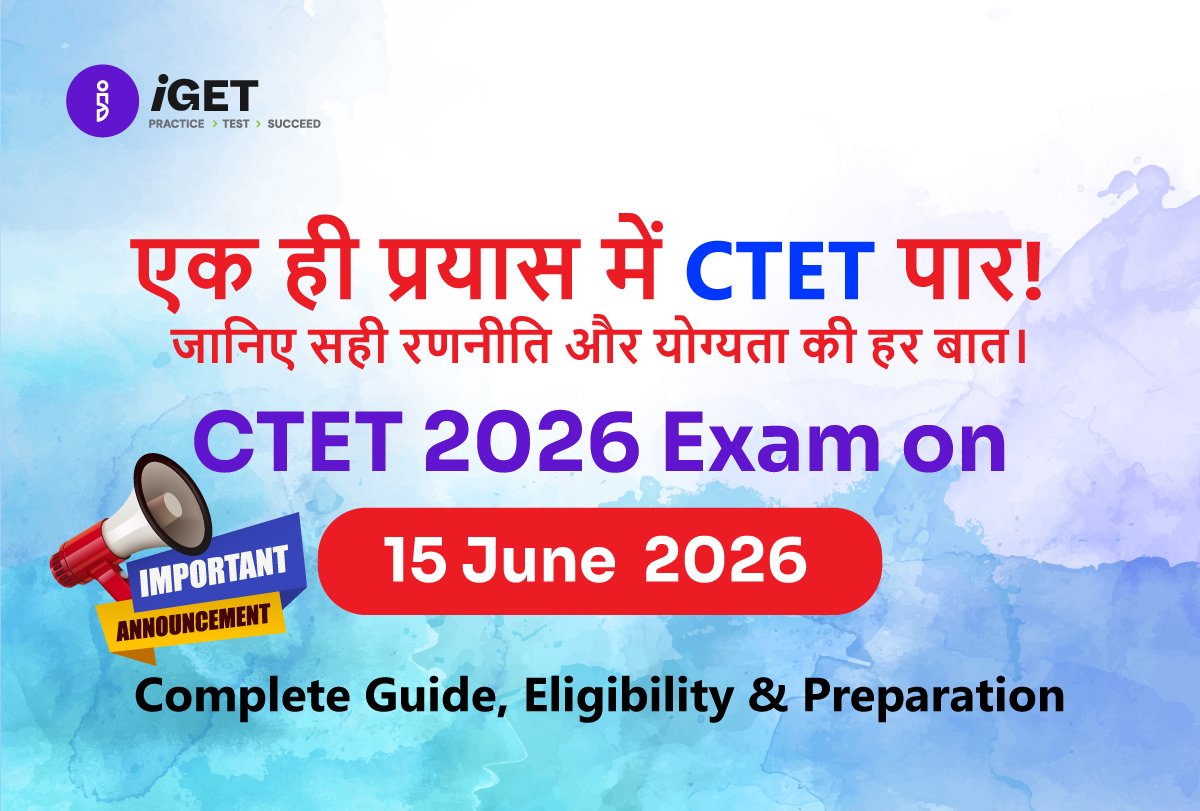
CTET 2026 is officially here. The Central Board of Secondary Education (CBSE) has confirmed that the Central Teacher Eligibility Test (CTET) will be conducted on 15 June 2026. This is a major update for lakhs of aspiring teachers across India who dream of securing a government teaching position. Whether you're targeting primary (Classes I–V) or upper primary (Classes VI–VIII) teaching roles, this comprehensive guide will walk you through every detail you need to know—from eligibility to exam strategy.
What is CTET 2026? Quick Summary
CTET stands for Central Teacher Eligibility Test, a national-level examination conducted by the CBSE to certify teachers for primary and upper-primary classes in central government schools and many state schools. The test is designed to assess pedagogical knowledge, subject expertise, and teaching aptitude.
The 2026 edition marks another opportunity for teaching aspirants to validate their qualification and improve employability across government and private institutions. Unlike one-time certification exams, CTET is held multiple times per year, giving candidates flexibility in planning their preparation timeline.
Key fact: CTET certification is valid for lifetime in most states, making it a one-time investment for your teaching career.
Important Dates & Deadlines for CTET 2026
Mark your calendar with these critical dates:
| Event | Expected Date |
| Official Notification Release | April 2026 (Already Released) |
| Online Application Start | Early May 2026 |
| Application Deadline | Late May 2026 |
| Admit Card Release | Early June 2026 |
| CTET Exam Date | 15 June 2026 |
| Result Declaration | July-August 2026 |
| Certificate Issuance | Within 30 days of result |
Note: Candidates are advised to check the official CTET website (ctet.nic.in) for exact dates as per the latest notification.
Eligibility Criteria for CTET 2026
Paper I (Classes I–V / Primary)
- 12th pass or equivalent from a recognized board
- Senior Secondary or Intermediate qualification
- Bachelor's degree in any discipline (preferred but not mandatory for 12th pass candidates)
- 2-year Diploma in Elementary Education (D.El.Ed) or Bachelor of Education (B.Ed) — either completed or ongoing
- Teaching qualification certified by RCI (Rehabilitation Council of India) — for candidates with hearing impairment
Paper II (Classes VI–VIII / Upper Primary)
- Bachelor's degree in any subject from a recognized university
- 2-year B.Ed or D.El.Ed (either completed or in final year)
- 1-year B.Ed (after bachelor's degree) — completed or final year ongoing
- Master's degree in any subject + 1-year B.Ed (ongoing)
Age Limit: No upper age limit. Minimum age is typically 18 years (check official notification for state-specific variations).
Nationality: Indian nationals only. Candidates must possess a valid Indian passport or other proof of citizenship.
Application Process: How to Apply for CTET 2026
Follow these step-by-step instructions to complete your CTET application:
- Visit Official Portal: Go to ctet.nic.in using any web browser (Chrome, Firefox, Safari).
- Click on "Register" Link: Look for the online registration/application portal. Click "New User? Register Here" if you're applying for the first time.
- Fill Registration Form: Enter your email address, mobile number, password, and security question. Verify your email via OTP.
- Log In to Application Portal: Use your registered credentials (email + password) to access the application form.
- Select Paper: Choose Paper I (Primary, Classes I–V) or Paper II (Upper Primary, Classes VI–VIII). You can apply for both by filling separate forms.
- Fill Personal Details: Enter full name, date of birth, gender, category (General/OBC/SC/ST), Aadhar number, address, and contact information with care (review twice).
- Enter Educational Qualifications: Add details of 12th, graduation, B.Ed/D.El.Ed, and any other relevant degrees. Upload mark sheets or certificates in PDF format (max 200 KB per file).
- Upload Recent Photograph: Use a colored passport-sized photo (3x4 cm, JPEG, max 50 KB). Ensure your face is clearly visible and background is neutral.
- Upload Signature: Scan your signature on white paper in black/blue ink. JPEG format, max 30 KB. Write signature without brackets or dates.
- Fill Additional Information: Complete any optional sections (disability certificate, state preference, etc.).
- Choose Exam Centers: Select your preferred test cities (typically 4–5 options available). CBSE assigns the nearest center.
- Review Application: Read through all entered details carefully. Mistakes cannot be corrected after submission.
- Pay Application Fee: CTET application fee is typically ₹1,000 (General/OBC) and ₹500 (SC/ST). Pay via online mode — debit card, credit card, net banking, or UPI. Keep a screenshot of receipt.
- Submit Application: Click "Submit" button. Note your application reference number for future correspondence.
- Download Confirmation Page: Save and print the application confirmation letter for your records.
Pro Tip: Complete your application at least 5 days before the deadline to avoid server congestion and technical glitches on the last day.
CTET Exam Pattern & Test Structure
Paper I (Primary: Classes I–V)
- Total Marks: 150
- Duration: 2.5 hours (150 minutes)
- Question Type: Multiple-choice (MCQ), single correct answer
- Number of Questions: 150 questions
- Negative Marking: None
- Language Medium: English, Hindi, and 18+ regional languages available
| Section | Topics | Questions | Marks |
| Child Development & Pedagogy | NCERT-based concepts of child development, learning theories, classroom management | 30 | 30 |
| Language I (English/Hindi/Regional) | Comprehension, grammar, sentence structure, pedagogy of language | 30 | 30 |
| Language II (Any Language) | Same as Language I but different language choice | 30 | 30 |
| Mathematics | Arithmetic, geometry, data handling, pedagogy of math (Classes I–V level) | 30 | 30 |
| Environmental Studies | Social studies, science concepts, EVS pedagogy (Classes I–V level) | 30 | 30 |
Paper II (Upper Primary: Classes VI–VIII)
- Total Marks: 150
- Duration: 2.5 hours (150 minutes)
- Question Type: Multiple-choice (MCQ)
- Number of Questions: 150
- Negative Marking: None
| Section | Topics | Questions | Marks |
| Child Development & Pedagogy | Adolescent development, inclusive education, assessment strategies | 30 | 30 |
| Language I | Reading comprehension, grammar, writing skills, language teaching methods | 30 | 30 |
| Language II | Same structure as Language I, different language | 30 | 30 |
| Mathematics & Science (Any One Subject) | Algebra, geometry, physics, chemistry, biology concepts + pedagogy (Classes VI–VIII level) | 30 | 30 |
| Social Studies (Any One Subject) | History, geography, civics, economics concepts + pedagogy (Classes VI–VIII level) | 30 | 30 |
CTET Syllabus 2026: What to Study
Child Development & Pedagogy (Common for Both Papers)
- Development: Concept of development, nature vs. nurture, stages of development (Piaget, Vygotsky)
- Learning Theories: Behaviorism, cognitivism, constructivism, social learning theory
- Individual Differences: Concept of intelligence, emotional intelligence, learning styles, multiple intelligences
- Inclusive Education: Inclusive schools and classrooms, barriers to learning, gifted and talented children
- Assessment & Evaluation: Formative and summative assessment, continuous comprehensive evaluation (CCE)
- Classroom Management: Classroom discipline, motivation, teacher-student relationship
Language Sections (Paper I & II)
Language I & II both focus on:
- Comprehension passages (unseen texts)
- Vocabulary and idioms
- Grammar (tenses, sentence structure, error correction)
- Reading and writing skills
- Pedagogy of language teaching
- Remedial teaching methods
Mathematics (Paper I & II)
- Paper I (Classes I–V): Number system, basic arithmetic, geometry, patterns, data handling, measurement concepts
- Paper II (Classes VI–VIII): Integers, fractions, decimals, algebra, geometry, statistics, trigonometry basics, pedagogy of math
Environmental Studies / Science & Social Studies (Paper I & II)
- Paper I: EVS covering plants, animals, natural resources, human body, hygiene, family, community (NCERT-based)
- Paper II: Physics, Chemistry, Biology (Classes VI–VIII NCERT) + History, Geography, Civics, Economics
Important: All content is strictly based on NCERT textbooks for respective classes. External reference books are not necessary; NCERT is sufficient and highly recommended.
Expert Preparation Tips & Strategy for CTET 2026
1. Start Early, Study Consistently
With the exam on 15 June 2026, candidates should begin preparation immediately. Allocate 4-6 months minimum for thorough coverage if starting from basic level. Break your syllabus into weekly targets rather than cramming last minute.
2. Master NCERT Textbooks First
CTET questions are 80% derived from NCERT books (Classes I–VIII). Read NCERT thoroughly at least twice: first for understanding, second for memorization. Make handwritten notes on key concepts, definitions, and theorems.
3. Focus on Child Development & Pedagogy
This is the highest-scoring section. Devote 30% of your study time here. Understand learning theories deeply, not just definitions. Connect theory to classroom practice.
4. Take Subject-Specific Mock Tests
Attempt full-length CTET mock tests every 2 weeks. Time yourself strictly (2.5 hours exactly). Analyze every wrong answer to identify weak topics. Aim for 60+ mock tests before the actual exam.
5. Language Section Strategy
Read English and Hindi newspapers/magazines daily. Solve comprehension passages for speed and accuracy. Practice grammar rules through active exercises, not just theory. Develop vocabulary through context reading.
6. Mathematics Practice Drills
Mathematics requires daily practice. Solve 15-20 problems daily from NCERT and other practice sources. Focus on problem-solving speed and conceptual clarity. Vedic maths tips can help boost calculation speed.
7. Create a Revision Schedule
Reserve the last 3 weeks entirely for revision. Don't attempt new topics. Instead, revise notes, redo weak-area questions, and take 3-4 full-length tests. Finalize your approach to each question type.
8. Join a Study Group or Coaching
Discussing difficult concepts with peers or mentors helps clarify doubts faster. Consider enrollment in a structured CTET preparation course if self-study feels overwhelming. Group discussions boost confidence and motivation.
9. Manage Stress & Health
Maintain 7-8 hours sleep daily. Exercise 30 minutes every morning for mental clarity. Avoid social media 2 hours before study sessions. Practice meditation or yoga to manage exam anxiety.
10. Day Before & Exam Day Tips
- Do NOT study new content the day before exam
- Sleep early the night before (at least 7-8 hours)
- Reach exam center 30 minutes early with all required documents
- Read all questions carefully before marking answers
- Manage time: allocate 1 minute per question (150 questions in 150 minutes)
- Don't panic if a few questions seem difficult—CTET has questions of mixed difficulty
CTET Cut-off & Merit Criteria 2026
Passing Score: Candidates must score a minimum of 60% marks (90/150) to qualify CTET and receive the eligibility certificate. There is no separate cut-off by category; merit is the sole criterion.
Previous Year Trends: In recent CTET exams, students scoring 100+ marks have better chances of selection in school recruitment. However, qualifying is the primary goal; once you pass, you remain eligible for teaching jobs.
Validity: CTET certificate is valid for lifetime in most Indian states. Some states specify 7 years validity, but even expired certificates help in resume building and interview credibility.
Career & Salary Prospects After CTET
Job Opportunities
- Government Schools: Central government schools (Kendriya Vidyalaya, Navodaya Vidyalaya) and state government schools across India accept CTET certificate. Salary: ₹9,300–₹34,800 (Pay Band I) + DA + other benefits.
- Private Schools: Most CBSE, ICSE, and state-board affiliated private schools hire CTET-qualified teachers. Salary ranges from ₹15,000–₹50,000+ depending on school reputation and location.
- Online Teaching Platforms: EdTech companies value CTET certification for recruiting online tutors and content creators. Salary: ₹10,000–₹30,000/month (part-time or full-time).
- Competitive Advantages: CTET is mandatory for central government school recruitment and preferred in state recruitment exams (UPTET, MPSET, REET, HTET, etc.).
Salary Breakdown (Government Teacher)
| Component | Amount (Approx.) |
| Basic Pay (Entry Level) | ₹9,300–₹15,000 |
| Dearness Allowance (DA) | ₹6,500–₹10,000 |
| House Rent Allowance (HRA) | ₹4,000–₹8,000 |
| Other Allowances | ₹2,000–₹5,000 |
| Total Monthly Salary | ₹21,000–₹40,000 |
Note: Salary varies by state, experience, and school category. Government teachers also enjoy pension, health insurance, and job security.
Frequently Asked Questions (FAQ)
1. When is CTET 2026 exam scheduled?
CTET 2026 is officially scheduled for 15 June 2026, as per the latest notification released by CBSE. The online application process typically opens in May 2026. Candidates should monitor ctet.nic.in for exact dates and any amendments.
2. What is the eligibility criteria for CTET 2026?
For Paper I (Primary): 12th pass + 2-year D.El.Ed or B.Ed (ongoing or completed). For Paper II (Upper Primary): Bachelor's degree + 2-year B.Ed or D.El.Ed (completed or final year). No upper age limit. Indian nationality required. Check official notification for state-specific variations.
3. How do I apply for CTET 2026 online?
Visit ctet.nic.in, register as a new user, fill the application form with personal and educational details, upload photograph and signature, select exam centers, pay application fee (₹1,000 for General/OBC, ₹500 for SC/ST), and submit. Save confirmation receipt for records.
4. What is the CTET exam pattern and total marks?
Both Paper I and Paper II have 150 questions for 150 marks, duration 2.5 hours each. Paper I (Classes I–V) covers Child Development, Language I, Language II, Mathematics, and Environmental Studies. Paper II (Classes VI–VIII) covers Child Development, Language I, Language II, and one subject each of Science/Math and Social Studies.
5. Is CTET syllabus based on NCERT only?
Yes, CTET syllabus is strictly NCERT-based. All content covers NCERT textbooks of Classes I–VIII. Reference books may help clarify concepts, but NCERT books are sufficient and highly recommended. About 80% of questions come directly from NCERT chapters.
6. What is the passing score and validity of CTET certificate?
Candidates must score minimum 60% marks (90/150) to qualify CTET. There is no separate cut-off by category. CTET certificate is valid for lifetime in most Indian states, making it a permanent teaching qualification. However, some states specify 7 years validity—check your state's recruitment rules.
📌 Source: Information based on latest reports and official notifications as of 05 May 2026. For the most accurate and updated details, candidates are advised to visit the CTET Official Website & PIB India. iGET is a learning resource portal — we do not represent any official authority. Verify all dates, eligibility, and procedures from official sources before applying.
