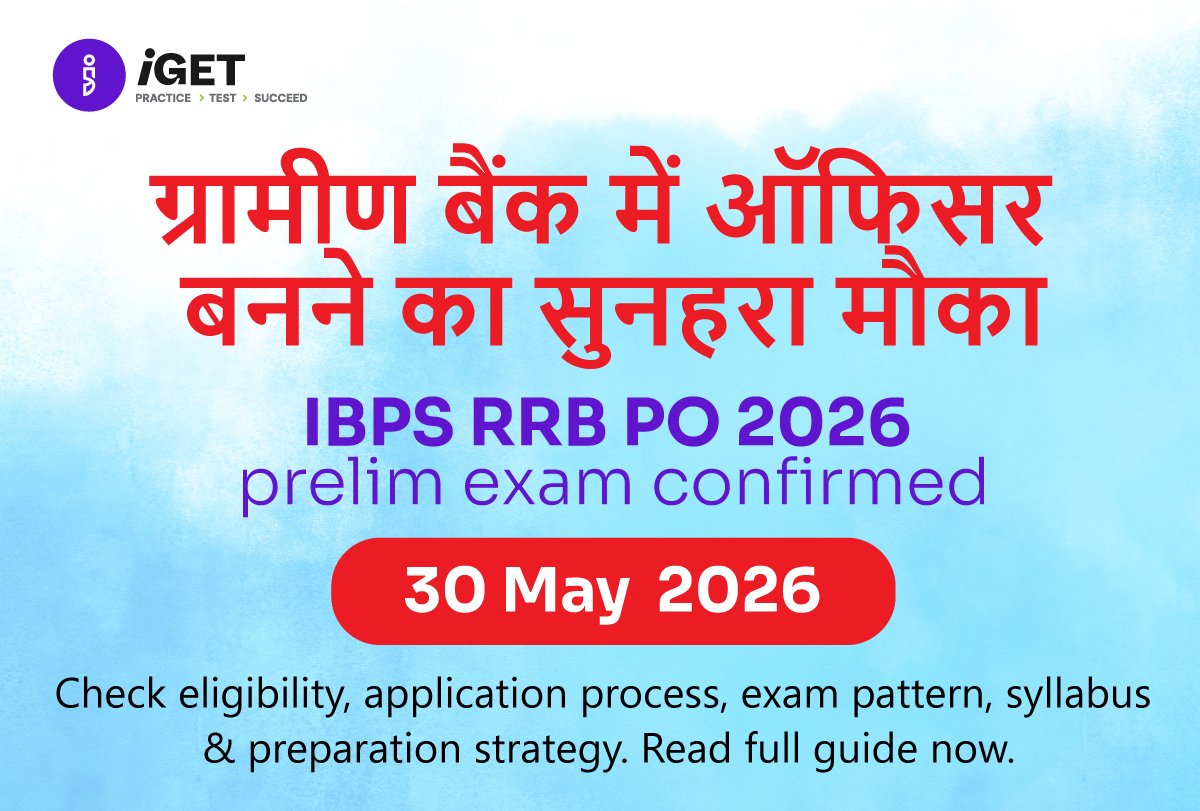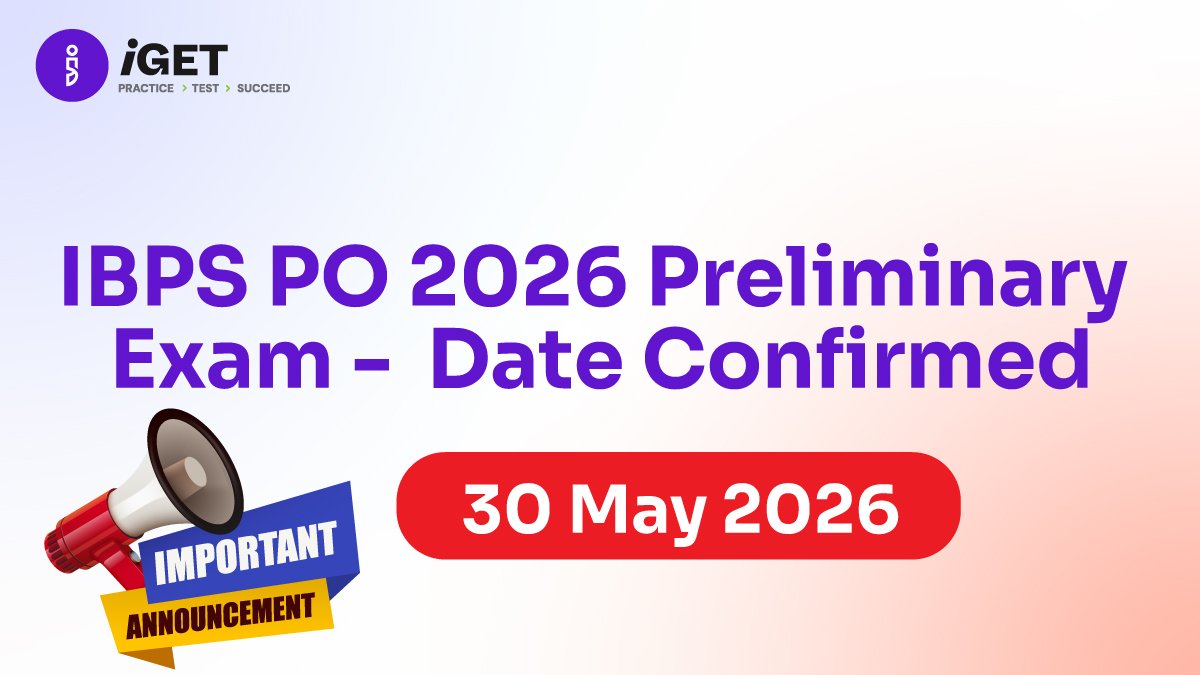
Breaking news for banking aspirants: The IBPS PO 2026 preliminary examination is now officially confirmed for 30 May 2026. This is your formal go-ahead to finalize application submissions and ramp up preparation intensity. The Institute of Banking Personnel Selection (IBPS) has released the official notification, and thousands of candidates across India are already racing against the clock. If you've been waiting for the exact exam date to crystallize your prep strategy, today is the day. This comprehensive guide covers everything—from eligibility norms to last-mile preparation hacks that top performers use.
What is IBPS PO 2026? Quick Overview
The IBPS Probationary Officer (PO) recruitment 2026 is one of India's most competitive banking exams, conducted by IBPS to fill vacancies across 12+ participating public sector banks. The exam follows a three-tier selection process: preliminary, main, and interview. The preliminary round acts as a screening stage—only candidates who clear it advance to the mains. With thousands applying for just a few hundred positions, understanding the exam structure and timeline is non-negotiable for serious contenders.
Why IBPS PO Matters
IBPS PO offers a prestigious career in public sector banking with fixed salary scales, job security, pension benefits, and growth opportunities. Selected candidates join as Probationary Officers and fast-track into Senior Management roles. The salary package typically ranges from ₹30,000–₹45,000 monthly at entry level, with substantial allowances.
Important Dates & Deadlines for IBPS PO 2026
Mark these dates in your calendar. Missing even one deadline can disqualify your application:
| Event | Expected Date (Approx.) | Remarks |
| Application Start | Mid-April 2026 | Online registration opens on official portal |
| Application Deadline | Early May 2026 | Candidates must apply before 11:59 PM on deadline date |
| Admit Card Release | Late May 2026 | Download from IBPS website using registration credentials |
| Preliminary Exam | 30 May 2026 | Confirmed — Online mode |
| Prelim Result | June 2026 | Shortlist for mains released within 3-4 weeks |
| Main Exam | Late June/Early July 2026 | Tentative — for prelim qualifiers only |
| Interview | August–September 2026 | Final round; weightage 100 marks out of 550 total |
Note: Dates are based on official IBPS announcements as of May 2026. Candidates should regularly check the official IBPS website for any updates or revisions.
IBPS PO Eligibility Criteria 2026
Before investing time in preparation, verify that you meet all eligibility requirements. The IBPS is strict about these norms:
- Nationality: Indian citizen, or a person from Nepal, Bhutan, Tibet, or Pakistani national of Indian origin (with valid documentation)
- Age Limit: 20–30 years (as on 01 May 2026). Age relaxation available for SC/ST (5 years), OBC (3 years), PWD (10 years), and ex-servicemen (as per Govt. rules)
- Educational Qualification: Bachelor's degree in any discipline from a recognized university. Final-year students may also apply, provided they submit proof of graduation by the interview date
- Work Experience: No specific prior experience required; fresh graduates are welcome
- Physical Fitness: Must be physically fit; no specific height/weight norms for PO role
- Technical Requirements: Must have an active email ID and valid mobile number for communication
Important Eligibility Notes
Candidates with disciplinary action pending, or those convicted of serious crimes, are barred. If you have outstanding dues with any bank or financial institution, disclose them during the application form. IBPS conducts rigorous document verification, so ensure all certificates are genuine and attested.
How to Apply for IBPS PO 2026 — Step-by-Step Process
The online application portal opens around mid-April. Here's the exact process:
- Visit the Official Portal: Go to www.ibps.in and locate the "IBPS PO Recruitment 2026" notification banner.
- Click 'Apply Online': Open the registration link and carefully read all instructions before proceeding.
- Register New Account: Enter your email ID and create a unique password. You'll receive a registration confirmation email immediately.
- Fill Application Form: Complete all mandatory fields—personal details, educational qualifications, work experience (if any), communication address, and emergency contact. Double-check spellings; errors can cause rejection during verification.
- Upload Documents: Scan and upload a recent color photograph (4×6 cm) and signature (3×1 cm) in prescribed formats. File size typically must not exceed 200 KB.
- Select Preferred Banks: Choose up to 5 banks where you wish to be posted. IBPS allows flexibility; allocation depends on merit and availability.
- Choose Exam Center: Select 3 preferred exam centers (for prelim and main). Allocation is based on convenience and IBPS logistics.
- Review & Submit: Review all details one final time before submission. Once submitted, changes are not allowed, so ensure accuracy.
- Make Payment: Application fee is ₹750 (₹325 for SC/ST/PWD candidates). Pay via net banking, credit/debit card, or NEFT. Fee exemption is not available; even PWD candidates must pay the reduced fee.
- Save Confirmation: After successful payment, download and save the application confirmation slip. This is proof of your submission.
Common Application Mistakes to Avoid
Don't rush. Many candidates miss deadlines or submit incomplete forms due to last-minute panic. Fill the form over 2–3 sittings, and keep a copy of all details offline. If your degree is from an unrecognized university, contact IBPS support beforehand; applying with such credentials will lead to automatic rejection at verification.
IBPS PO Preliminary Exam Pattern & Structure
The preliminary exam is the gateway. Understanding its format is essential for effective time management:
| Section | Number of Questions | Maximum Marks | Duration |
| English Language | 30 | 30 | 60 minutes (1 hour) |
| Quantitative Aptitude | 35 | 35 | |
| Reasoning Ability | 35 | 35 | |
| TOTAL | 100 | 100 | 60 minutes |
- Mode: Online (Computer-Based Test)
- Marking: Each correct answer = 1 mark. Each wrong answer = -0.25 mark (negative marking)
- Medium: English and Hindi (candidates choose at the time of exam)
- Sectional Cutoff: IBPS typically sets both overall and sectional cutoffs. Scoring only in 2 sections won't qualify you if you fail a section
Preliminary Exam Strategy
With just 60 minutes for 100 questions, speed and accuracy are paramount. Allocate approximately 20 minutes per section. Don't get stuck on a single tough question; mark it for review and move ahead. Negative marking is harsh, so avoid wild guessing. Attempt only those questions where you're 70% confident.
IBPS PO Syllabus & Key Topics 2026
The preliminary syllabus is vast but predictable. Here's what you need to cover:
English Language (30 marks)
- Reading Comprehension: 2–3 passages, 8–10 questions. Topics range from economics, environment, social issues to technology
- Cloze Test: 5–10 blanks in a coherent paragraph
- Error Spotting / Sentence Correction: Grammar-based questions; identify and correct errors in tense, subject-verb agreement, prepositions
- Para Jumbles: Rearrange scrambled sentences to form a coherent paragraph
- Vocabulary: Synonyms, antonyms, word substitution in sentences
- Phrase / Idiom Meaning: "Call a spade a spade," "Piece of cake," etc.
Quantitative Aptitude (35 marks)
- Number System: HCF, LCM, divisibility rules, prime numbers
- Simplification & Approximation: BODMAS rule, surds, indices
- Percentage: Profit-loss, discount, markup, successive percentage changes
- Average & Ratio: Mean, weighted average, proportion, mixture problems
- Time & Work: Work rate, pipes & cisterns, work efficiency
- Time, Speed & Distance: Relative speed, boats & streams, circular motion
- Simple & Compound Interest: Principal, rate, time calculations
- Data Interpretation (Prelim level): Simple bar charts, pie charts, tables. Not as complex as mains
Reasoning Ability (35 marks)
- Syllogism: Logical deduction from two premises
- Inequality: Comparing values using symbols (>, <, =, ≥, ≤)
- Seating Arrangement (Linear & Circular): Position-based logic puzzles
- Coding-Decoding: Pattern recognition; numbers/letters substituted with symbols
- Direction & Distance: Movement on a grid; compass directions
- Blood Relations: Family tree problems
- Order & Ranking: Determine position in a sequence
- Analogy: Relationship between word pairs
- Statement & Conclusion: Logical inference from given statements
Proven Preparation Strategy & Tips for 2026
Prelim is primarily about speed and accuracy. Here's a battle-tested approach:
Phase 1: Concept Building (Weeks 1–3)
Don't jump straight to practice papers. Spend the first 3 weeks solidifying fundamentals. For quantitative aptitude, revisit basic formulas and problem-solving techniques. For English, study grammar rules, common idioms, and reading strategies. For reasoning, understand logical operators and practice seating arrangements methodically. Use YouTube channels, coaching notes, or books like "Quantitative Aptitude for Competitive Exams" by R.S. Agarwal.
Phase 2: Topic Mastery & Targeted Practice (Weeks 4–6)
Once concepts are clear, solve 50–100 questions per topic. Track which topics drain your time. If number systems take 15 minutes for 10 questions, that's a red flag. Focus on speed drills for weak areas. Use dedicated IBPS PO practice tests to identify patterns.
Phase 3: Full-Length Mock Tests (Weeks 7–8)
Take 2–3 full-length mocks per week, simulating exam conditions. Set a timer for exactly 60 minutes, no breaks. Review mistakes after each test, not during. Track your score trajectory. If your mock scores are below the expected cutoff (typically 60–65 out of 100), increase daily practice to 4–5 hours.
Phase 4: Final Revision & Speed Optimization (Last 7 Days)
Stop learning new topics. Revise formulas, shortcuts, and common mistakes. Solve 2–3 previous years' papers (if available). Get 7–8 hours of sleep every night; fatigue hampers accuracy. On 28–29 May, take light practice and focus on mental preparation.
Key Tips from Top Scorers
- Create a formula sheet: Write down all important formulas, shortcuts, and rules on a single sheet. Refer to it daily.
- Follow the 80/20 rule: 20% of topics yield 80% of questions. Prioritize high-frequency areas (simplification, arithmetic, reading comprehension, syllogism).
- Time management is your ally: Ideally, aim to complete the exam in 50 minutes, leaving 10 minutes for review and corrections.
- Don't over-attempt: Attempting 95 questions with 70% accuracy (66.5 marks after negative marking) beats attempting all 100 with 65% accuracy (61.25 marks after negative marking).
- Stay updated: Current affairs questions appear occasionally in English/reasoning. Read newspapers or follow current affairs apps.
Selection Process: From Prelim to Offer Letter
Clearing prelims is just the beginning. Here's what awaits qualifiers:
Main Examination (Score: 200 marks)
Scheduled for late June or early July 2026. Longer duration (3 hours), higher difficulty. Sections include General Awareness, Finance & Economics, Reasoning, Quantitative Aptitude, English, and Computer Knowledge. Data Interpretation is more complex here, with multi-step calculations required.
Personal Interview (Score: 100 marks)
Top scorers from mains are called for interviews (typically 5–7× the vacancy count). IBPS often features group discussions before individual interviews. Topics span current affairs, banking sector updates, and role-specific knowledge. Personality, communication skills, and conviction matter as much as subject knowledge.
Document Verification
Finally selected candidates undergo strict verification of educational certificates, caste certificates (if applicable), and criminal background checks. Any discrepancy can lead to disqualification even after interview success.
Career Prospects & IBPS PO Salary in 2026
IBPS PO is a coveted role for good reason:
- Starting Salary (CTC): Approximately ₹35,000–₹45,000 per month (basic + DA + allowances), depending on the bank and location
- In-hand Salary: Typically ₹28,000–₹32,000 after taxes and deductions
- Perks: Medical allowance, house rent allowance, transport allowance, clothing allowance, and travel concessions
- Job Security: Permanent position in public sector; job security unmatched in private banking
- Pension: New Pension Scheme (NPS) applicable; government provides matching contribution
- Career Growth: After 4–5 years, promotion to Senior PO, then to circle-level management roles. Officers reaching AGM/DGM levels earn ₹1.5+ lakh per month
- Work Location Flexibility: During probation, you're posted across the nation. After, transfers are limited and tenure-based
Frequently Asked Questions
When is the IBPS PO 2026 preliminary exam scheduled?
The preliminary exam is officially confirmed for 30 May 2026. It will be conducted online (CBT mode) across multiple exam centers in India. Admit cards are expected to be released a few days before the exam date.
What is the eligibility age for IBPS PO 2026?
Candidates must be between 20 and 30 years old as of 1 May 2026. Age relaxation is available: SC/ST candidates get 5 years relaxation (maximum 35 years), OBC candidates get 3 years (maximum 33 years), PWD candidates get 10 years (maximum 40 years), and ex-servicemen are eligible as per government norms.
How do I apply for IBPS PO 2026?
Visit the official IBPS website (www.ibps.in), click on the IBPS PO recruitment notification, and fill the online application form with your personal, educational, and banking preference details. After uploading required documents (photo and signature), pay the application fee (₹750 or ₹325 for SC/ST/PWD) via online banking. Save your confirmation slip.
What is the IBPS PO preliminary exam pattern?
The prelim consists of 100 multiple-choice questions (100 marks total) covering three sections: English Language (30 questions), Quantitative Aptitude (35 questions), and Reasoning Ability (35 questions). The exam duration is 60 minutes. Each correct answer earns 1 mark, and each incorrect answer incurs a -0.25 mark penalty (negative marking).
What are the main topics in the IBPS PO syllabus?
For preliminary: English (reading comprehension, cloze test, grammar, para jumbles); Quantitative Aptitude (number system, simplification, percentage, average, ratio, time-work, time-speed-distance, interest, data interpretation); Reasoning (syllogism, inequality, seating arrangement, coding-decoding, direction, blood relations, analogy, statement-conclusion). Main exam adds General Awareness, Finance & Economics, and Computer Knowledge.
What is the expected salary and career growth after becoming an IBPS PO?
Starting monthly salary (in-hand) is approximately ₹28,000–₹32,000, with annual increments. Total CTC including allowances and benefits ranges from ₹35,000–₹45,000 monthly. After 4–5 years of service and performance, promotions to Senior PO and circle-level management are common. Senior-level officers earn ₹1.5+ lakh monthly. Public sector job security, pension, and medical benefits add significant value.
When is the application deadline for IBPS PO 2026?
The exact application deadline hasn't been announced yet but is expected in early May 2026 (approximately 1–7 May). Candidates are advised to monitor the official IBPS website (www.ibps.in) for the precise date. Applications are typically accepted on a rolling basis, and the deadline is strictly enforced with no extensions.
Is negative marking applicable in IBPS PO prelim exam?
Yes, negative marking is strictly enforced. Each wrong answer attracts a penalty of -0.25 marks (1/4th of the mark allocated to that question). This makes accuracy more important than speed. Even one extra wrong answer can cost you dearly in a competitive exam where margins are thin.
📌 Source: Information based on latest reports and official notifications as of 04 May 2026. For the most accurate and updated details, candidates are advised to visit the Official IBPS Website. iGET is a learning resource portal — we do not represent any official authority. Verify all dates, eligibility, and procedures from official sources before applying.